UK Test-Optional vs. Test-Flexible: What Do They Mean for 2027 Applicants?

Updated November 2026

Can you get into a UK university without taking the SAT or ACT? In many cases, yes. But that doesn't necessarily mean you can apply without other academic qualifications or exam results.

UK universities have different ways of evaluating American students. Some don't require SAT or ACT scores, while others accept several combinations of AP exams, college-level coursework, GPA, and standardized tests.

This is where the terms test-optional and test-flexible come in.

What's the difference?

Test-optional generally means you aren't required to submit a particular test, often the SAT or ACT, as part of your application.

Test-flexible means a university accepts different combinations of academic qualifications to meet its entry requirements.

The important thing to understand is that not requiring SAT or ACT scores doesn't mean a UK university has no academic entry requirements.

Let's look at how these policies work, what UK universities may accept, and what American students applying for 2027 entry should check before choosing their courses.

How Have UK University Testing Requirements Changed?

Before the COVID-19 pandemic, many UK universities evaluated American applicants using a combination of AP exams, SAT or ACT scores, and high school grades.

When the pandemic disrupted access to standardized testing, universities reviewed their admissions requirements and, in some cases, introduced more flexibility in the qualifications they would accept.

But the shift wasn't universal, and not every university followed the same approach.

Today, some UK universities accept AP exams or college-level coursework without SAT or ACT scores. Others still require standardized test results or accept them as part of several possible qualification combinations.

What does this mean for 2027 applicants?

For students applying in 2027, the important question isn't whether a university changed its requirements during COVID. It's which qualifications the university accepts now for your chosen degree.

What Does Test-Optional Mean for UK Universities?

When a university is described as test-optional, it generally means applicants can choose whether to submit certain standardized test scores.

For American students applying to UK universities, this most commonly refers to the SAT or ACT.

For example, a university might not require an SAT or ACT score if you can demonstrate your academic preparation through AP exams, dual enrollment courses, or other accepted qualifications.

However, there's an important difference between a university that doesn't require the SAT or ACT and one that doesn't require any external exams.

A university may be SAT/ACT optional but still require AP exam results or specific academic subjects.

Unlike many US colleges, UK universities generally admit students directly into a particular degree course. That means your academic preparation in the subject you want to study is especially important.

If you're interested in studying engineering, for example, a university may require evidence of advanced mathematics, even if it doesn't ask for SAT or ACT scores.

The key is to look beyond the test-optional label and check the qualifications required for your specific course.

What Does Test-Flexible Mean for UK Universities?

Test-flexible admissions give students different ways to demonstrate that they meet a university's academic entry requirements.

Instead of requiring one fixed combination of qualifications, a university might accept several alternatives.

Depending on the institution and degree, these could include:

  • Advanced Placement (AP) exam scores
  • SAT or ACT scores
  • Dual enrollment or college-level courses
  • Advanced or honors-level high school classes
  • A US High School Diploma and minimum GPA
  • A combination of the above

Not every university accepts every qualification, and the required grades or scores can vary.

An Example of Test-Flexible Admissions

The University of Edinburgh provides a useful example.

For many undergraduate courses, Edinburgh lists several combinations of standardized qualifications that can meet its general minimum requirements, including:

  • Three AP exam scores of 4 or higher in different subjects
  • Two AP exam scores of 4 or higher, plus an ACT composite score of at least 27
  • Two AP exam scores of 4 or higher, plus an SAT score of at least 1290, including minimum section scores

Edinburgh also publishes alternative routes involving advanced or college-level coursework for eligible applicants studying in the United States.

However, these are general minimum requirements. Individual degree courses may require higher grades or particular subjects, and meeting the minimum does not guarantee admission.

The takeaway? Two students applying to the same university may be able to qualify using different combinations of academic credentials.

That's what makes understanding test-flexible admissions so useful when planning your high school courses and exams.

Test-Optional vs. Test-Flexible: What's the Difference?

Here's a quick comparison:

Feature Test-Optional Test-Flexible
What it means A particular test isn't required. Different combinations of qualifications are accepted.
SAT/ACT May not be required. May be one of several accepted options.
AP exams May still be required. May be accepted alone or alongside other qualifications.
GPA and coursework May be considered as part of the requirements. May help satisfy an alternative qualification route.
Subject requirements Can still apply. Can still apply.

These terms aren't universal UK admissions categories. Universities may describe their requirements differently, so it's more useful to check the actual entry criteria than to rely on either label.

Do UK Universities Require SAT, ACT, or AP Exams?

The answer depends on the university, the degree course, and the qualifications you've completed.

Let's break down the main credentials American students may encounter.

SAT and ACT Scores

Some UK universities accept SAT or ACT scores as part of their entry requirements. Others allow students to qualify through AP exams or advanced coursework without submitting either test.

But don't assume that every UK university has dropped SAT and ACT requirements.

For example, the University of Cambridge's published guidance for 2027 entry typically expects US applicants to present five AP scores of 5 in relevant subjects, a high SAT or ACT score, and a strong high school GPA.

That is very different from a university that accepts advanced coursework in place of standardized tests.

Tip: If you're planning to apply to several UK universities, check their requirements before deciding whether to skip the SAT or ACT. A score you don't need for one university might be important for another.

Advanced Placement (AP) Exams

AP exams are an important qualification for many American students applying to UK universities.

Because UK students typically specialize in fewer subjects during the final years of secondary school, universities often use AP results to assess whether American applicants have reached a comparable level of academic preparation.

You can learn more in our guide to AP Exams and UK Study.

However, taking an AP class isn't always the same as achieving an AP exam score.

Some universities specifically require the external AP exam result. Others may consider advanced classes or college-level coursework as alternatives.

You'll also want to check whether your chosen degree requires particular AP subjects.

Dual Enrollment and Honors Classes

What if your high school doesn't offer many AP classes?

You may still have options.

Some UK universities accept dual enrollment, college-level, or advanced high school coursework as part of their entry requirements.

For example, Cardiff University publishes undergraduate entry routes for American applicants that can include AP tests, dual enrollment or honors classes, or combinations of accepted qualifications. Its general guidance also requires a US High School Diploma with a minimum GPA of 3.0.

The University of Manchester also accepts combinations of AP exams and dual enrollment or college-level classes for many courses, alongside its published diploma and GPA requirements.

These examples show why it's important to look at the qualifications you already have before assuming you need to register for additional exams.

If you're taking dual enrollment courses, check whether the university requires particular subjects, grades, credit levels, or documentation.

What About Subject-Specific Requirements?

This is one of the most important parts of applying to a UK university.

In the US, students often apply to a college and choose or confirm their major later. In the UK, students usually apply directly to a specific degree course.

As a result, universities may expect you to have studied certain subjects before you arrive.

For example:

  • Engineering: Advanced mathematics, and sometimes physics, may be required.
  • Biological sciences: Biology, chemistry, or both may be required.
  • Economics: Some courses require advanced mathematics.
  • Medicine: Specific science qualifications and additional admissions testing are commonly required.

The exact requirements vary, even between universities offering degrees with similar names.

For example, the University of Edinburgh lists AP Calculus requirements for certain economics degrees and specific science requirements for biomedical sciences.

If you're considering a STEM degree in the UK, reviewing these requirements early can help you choose the right AP classes, exams, or advanced coursework.

Important: Even if a university accepts SAT or ACT scores, those scores may not replace a required subject qualification.

How to Check UK University Entry Requirements for 2027

Not sure where to start? Here's a practical way to figure out which qualifications you'll need.

1

Start With the Degree You Want to Study

UK university entry requirements are often course-specific.

Instead of looking only at a university's general admissions page, find the undergraduate degree you're interested in and review its entry requirements.

A university might have different requirements for business, psychology, engineering, and medicine.

2

Find the Requirements for US Students

Many UK universities have a dedicated page for applicants from the United States.

Look for headings such as:

  • USA entry requirements
  • International qualifications
  • United States undergraduate admissions
  • Accepted international qualifications

These pages explain how American qualifications may be evaluated against UK requirements.

You can also read our guide to UK University Entry Requirements for additional background.

3

Make a List of Your Academic Qualifications

Before comparing universities, write down what you already have and what you're planning to complete.

Include your:

  • Current GPA
  • AP classes and exam scores
  • AP exams you plan to take
  • SAT or ACT scores, if available
  • Honors and advanced classes
  • Dual enrollment or college-level courses
  • Intended university degree subject

This gives you a clearer picture of which entry routes may be available.

Remember that universities may consider predicted results for qualifications you're still completing.

4

Check for Required Subjects and Additional Admissions Tests

A university's general entry requirements are only part of the picture.

Some degrees require particular subjects, portfolios, interviews, or additional admissions tests.

For example, certain medicine courses require the University Clinical Aptitude Test (UCAT), while other competitive courses may have their own assessments.

These requirements are separate from whether the university accepts SAT or ACT scores.

Always check the individual course page for additional selection requirements and deadlines.

5

Contact Admissions if Your Qualifications Don't Fit Neatly

What if your high school doesn't offer AP exams, or you've completed an unusual combination of honors and college-level courses?

Don't automatically rule out a university.

Contact its admissions team with your intended course, academic transcript, and details of your qualifications.

Ask whether your combination meets the requirements or whether another accepted route is available.

It's much better to clarify this before applying than to discover later that you're missing a required subject or exam.

What if You Don't Meet the Entry Requirements?

Not meeting a university's standard entry requirements doesn't necessarily mean studying in the UK is off the table.

Depending on the university and course, you may be able to consider a foundation year or another preparatory pathway.

A foundation year is designed to help students develop the academic preparation needed before progressing to a degree. Some are integrated into a university program, while others are offered through separate pathway providers.

However, foundation programs have their own entry requirements, costs, and progression conditions.

If you're considering this option, check whether successful completion leads to your intended degree and what grades you'll need to progress.

How The UK Study Expert Can Help

With different requirements for every university and course, it's easy to see why applying to UK universities can feel like solving a puzzle.

The good news is that you don't have to start from scratch.

Find Your UK University Matches

Our free UK University Match Quiz helps you discover potential university options based on your interests and academic profile.

Take the Free University Match Quiz →

Search by Your Qualifications

Explore universities and narrow your options using qualifications such as GPA, AP exams, SAT or ACT scores, and your intended subject.

Explore the UK University Search Tool →

Get Application Guidance

Our team can help you understand your options, develop a university shortlist, and prepare for the application process.

Explore Student Admissions Support →

Prepare for UCAS 2027

Our 2027 UCAS Guide for US Students walks you through entering American qualifications, completing your personal statement, and submitting your application.

Explore the 2027 UCAS Guide →

The Bottom Line

You don't necessarily need SAT or ACT scores to apply to a UK university in 2027. But you do need to demonstrate that you meet the academic requirements for your chosen degree.

Some universities accept several combinations of AP exams, advanced coursework, GPA, and standardized tests. Others have more specific expectations.

The best approach is to choose your degree, check the university's requirements for US applicants, and build your application plan around the qualifications it accepts.

That way, you'll know which exams you need, which ones you may be able to skip, and which UK universities are a potential match for your academic profile.

Find Your UK University Matches →


AP Exam Guide for University Admission: What US Students Need to Know

If you’ve been researching US entry requirements for UK universities, you may have noticed that many universities ask American students for AP exam scores.


But how strict are UK universities when it comes to AP exams? How many do you need? Do the subjects matter? And what happens if your high school doesn’t offer AP classes at all?


The good news is that AP exams aren’t the only way US students can meet UK university entry requirements. Depending on the university and program, there may be other options.


Let’s break down how UK universities view AP exams and what you can do if APs aren’t part of your academic profile.

How AP Exams Are Viewed in the UK

AP exams are one of the most widely accepted ways for US students to meet academic entry requirements for UK universities.


Why?


UK universities typically evaluate applicants using subject-based qualifications such as A-Levels. Because AP exams also demonstrate advanced knowledge in individual academic subjects, universities can use AP scores to determine whether a US student has reached a comparable academic level.


However, there isn’t one AP requirement that applies to every UK university.


One university may ask for several AP exams, while another may accept a combination of AP scores and SAT or ACT scores. Some universities may also consider other qualifications or academic evidence.


The degree you’re applying to matters too.


If you’re applying for a program with specific subject requirements, such as engineering, mathematics or certain sciences, the university may require an AP exam in that particular subject.


So before deciding whether you have the right AP exams, always look at the entry requirements for the
specific university and program you’re considering.

How Many AP Exams Do You Need for UK Universities?

There isn’t one magic number.


Depending on the university and program, you may see requirements such as:

  • Three AP exams at specified scores
  • Four or five AP exams for programs with higher entry requirements
  • Two AP exams combined with qualifying SAT or ACT scores
  • Specific AP subjects for the degree you want to study
  • Alternative academic qualifications if AP exams aren’t available at your school


For example, the University of Edinburgh currently lists three AP scores of 4 or higher as one combination that can meet its minimum standardized testing requirements for many programs. Students may also meet those requirements through combinations such as an SAT or ACT score plus two AP exams.


At UCL, requirements can range from three to five AP subjects depending on the A-Level requirements for the particular degree.


This is why it’s so important to check each university and program individually. Meeting the general US entry requirements for a university doesn’t necessarily mean you’ve met the requirements for the degree you want to study.

Do Your AP Subjects Matter?

Yes!


This is one of the biggest differences US students need to understand about applying to universities in the UK.


In the US, students typically apply to a university and may have time to explore different subjects before officially declaring a major.


In the UK, you’re applying directly to a specific degree from the beginning.


Because of this, some programs require students to demonstrate previous knowledge in particular subjects.


For example, a mathematics-heavy program may require an AP Calculus exam, while a science program may require specific AP science subjects.


Having several strong AP scores doesn’t necessarily meet the requirements if you haven’t taken the subjects required for your chosen program.


When researching universities, make sure you’re looking at both:

  • The university’s general requirements for US students
  • The entry requirements for the specific degree you want to study

What If Your High School Doesn’t Offer AP Exams?

First, don’t assume that not having access to AP exams automatically rules you out of studying in the UK.


UK universities understand that AP availability varies between US high schools, and some universities provide alternative ways for students to demonstrate their academic preparation.


Start by talking with your school’s college counselor.


If you have a dream university in mind, ask your counselor if they’ve had previous students apply there. They may already have experience with the university or know its US admissions representative.


Even if they haven’t worked with that particular university before, your counselor may be able to help explain your school’s curriculum and the academic opportunities that were available to you.


This can be important when a university is reviewing a student from a school that doesn’t offer AP courses.


For example, the University of Edinburgh currently has an alternative review process for students whose schools don’t follow an AP curriculum and where AP exams aren’t available. In those situations, the university may consider the student’s GPA, the rigor of their high school curriculum, honors or college-level classes and other academic evidence.


The important distinction is that your school
doesn’t offer APs, rather than simply choosing not to take AP exams that were available to you.

Look for UK Universities With Alternative US Entry Requirements

If AP exams aren’t part of your academic profile, your next step is to look for universities that offer other ways for US students to meet their entry requirements.


Depending on the university and program, those alternatives may include:

  • SAT or ACT scores
  • Honors or other advanced coursework
  • Dual enrollment or college classes
  • An associate’s degree
  • International Baccalaureate qualifications
  • Your high school GPA and overall curriculum
  • A university foundation program
  • Other university-specific qualifications


Again, there isn’t one rule across the UK.


Some universities are more flexible than others, and requirements can even vary between programs at the same university.


That’s why we recommend starting with the universities and programs that interest you and then looking closely at how each one evaluates US qualifications.

Can Honors, Dual Enrollment or College Classes Replace AP Exams?

Sometimes!


Depending on the university, honors classes, dual enrollment or other college-level coursework may be considered when evaluating your application.


Dual enrollment and college coursework can be particularly helpful because they show that you’ve already completed university-level study.


However, there isn’t a universal number of college credits that automatically replaces AP exams.


Universities set their own requirements, and they may consider:

  • How much college coursework you’ve completed
  • Your college GPA
  • The subjects you’ve studied
  • How those subjects relate to your intended degree
  • Whether you’ve completed any required prerequisite subjects


For example, UCL currently lists successful completion of one year at a recognized US university, community college or junior college with a qualifying GPA as one possible route for US applicants.


If you’ve already completed significant college coursework or an associate’s degree, your situation may be a little different.
Read our guide to Transferring From a US College to a UK University to learn more about how UK universities may evaluate your previous college study.


Not Sure Which UK Universities Fit Your Academic Profile?

With so many different requirements, it can be difficult to figure out which universities might be a good fit based on your AP scores, GPA and other qualifications.

Take our UK University Match Quiz to start narrowing down your options based on your academic profile and study goals.

Find Your UK University Match →


Can You Self-Study for an AP Exam?

Yes.


If the university you want to attend requires an AP exam that your school doesn’t offer, you may still be able to take the exam without taking the AP course at your high school.


College Board allows students to arrange to take an AP exam at another school that administers it.


If your school doesn’t offer the AP exam you need, you can use College Board’s AP Course Ledger to find nearby schools that offer that exam. You’ll then need to contact the school’s AP coordinator to find out whether they allow students from other schools to test there.


Start this process as early in the school year as possible.


Schools can set their own deadlines and policies for accepting outside students, and AP exam orders are generally finalized in the fall.


Of course, self-studying for an AP exam isn’t necessarily the easiest option. AP exams cover a significant amount of material, and you’ll be preparing without taking the corresponding AP course.


But if a particular AP is required for a program you really want to pursue, it’s an option worth exploring.


You can find the current instructions for arranging an AP exam through the College Board website.

How to Find UK University Entry Requirements

At this point, you might be asking yourself:


How am I supposed to figure out which universities accept AP exams, SAT or ACT scores, honors classes, college coursework or other qualifications?


That’s exactly why we’ve created our Undergraduate University Search Tool.


Instead of trying to search every UK university website individually, you can use the tool to explore universities and see which ones may match your academic profile.


Remember that entry requirements can vary by program, so once you find universities you’re interested in, always confirm the requirements for your specific degree before applying.

Find UK Universities That Match Your Qualifications

Ready to start looking at your options?


Use our
Undergraduate University Search Tool to explore UK universities and compare their US entry requirements.


Whether you have AP exams, college coursework or a different academic profile, this is a great place to start narrowing down your university list.

Search UK Universities →


About the Author:

Ashley Jeanson is an international education expert with over 9 years of experience in the field. She’s worked for a mixture of study abroad providers, universities in the US and the UK, and third-party providers, mostly specializing in helping American students attend UK universities. In her spare time, she travels the globe and is eternally in search of the best cup of coffee.


Are UK Universities Accredited and Recognized in the US?

One question we get a lot from American students is whether UK universities are accredited, which is really another way of asking: Will my UK degree be recognized and accepted in the United States?

You'll be happy to know that the answer is generally yes!

Degrees from officially recognized UK universities can be accepted by US employers and graduate schools. However, the UK accreditation system works a little differently from what you're probably used to in the US, and there are a few exceptions for certain professions.

Here's what you should know before choosing a UK university.

How UK University Accreditation Works

In the United States, you're probably familiar with colleges and universities being described as accredited.

The UK has its own system for recognizing universities and maintaining academic standards. Rather than relying on one accrediting organization, UK universities and other recognized institutions must have official degree-awarding powers to award their own degrees.

Some colleges also offer programs where the degree is awarded by another recognized university, so it's important to know which institution will award your qualification.

The Quality Assurance Agency for Higher Education (QAA) plays an important role in supporting academic quality and standards across UK higher education, although it isn't the organization that accredits every UK university.

Universities also use external examiners, often academics from other institutions, to help review assessments and maintain academic standards.

Want to check whether a UK university is officially recognized? The UK government has a helpful resource where you can check if an institution can award recognized degrees.

Using Your UK Degree in the United States

So, can you bring your UK degree back to the US and use it?

In many cases, absolutely!

UK degrees from officially recognized institutions can be accepted for employment and further education in the United States.

For most jobs, it's up to the employer to decide whether your degree meets its requirements. And if you're planning to attend graduate school in the US, the university will determine whether your UK qualification meets its admissions criteria.

Sometimes, an employer or university may ask for a credential evaluation. This is simply a review of your international degree to determine how it compares with a US qualification.

Not everyone needs one, and the organization reviewing your degree will usually let you know if it's required.

You can learn more about how foreign qualifications are recognized through the US Department of Education.

Degrees That May Require Additional Licensing

As always, there are a few exceptions to the rule!

If you're planning to enter a profession that requires a license in the United States, you may need additional exams, coursework, supervised experience, or a credential evaluation before you can practice.

Some examples include:

  • Nursing: Additional evaluation or licensing exams may be required.
  • Teaching: Requirements vary by state, and UK teaching qualifications may not transfer directly.
  • Medicine: Graduates of international medical schools must meet additional requirements to practice in the US.
  • Social Work: State licensing boards may have specific education and experience requirements.
  • Physical Therapy and Occupational Therapy: Additional credential evaluations or licensing requirements may apply.
  • Law: Eligibility to take the bar exam with a UK law degree varies by state.
  • Architecture: Additional education, experience, or examinations may be needed.
  • Psychology: Professional licensing, particularly for clinical practice, may require specific graduate education and supervised training.

This doesn't mean you shouldn't study these subjects in the UK! It just means you'll want to do a little extra research before choosing your degree.

We always recommend contacting the relevant US state licensing board or professional organization to confirm whether the specific UK degree you're considering will meet its requirements.

What About Other UK Degrees?

For students studying subjects like humanities, mathematics, business, and many areas of science, additional professional licensing often isn't necessary simply because you earned your degree in the UK.

Of course, individual employers and graduate schools may still have their own requirements.

The important thing is to think about what you want to do after graduation and make sure your chosen degree will help you get there.

For most American students, studying at a recognized UK university can be a great option, whether you're planning to stay abroad, return home for work, or continue your education.

Ready to Explore UK Universities?

If you're thinking about studying in the UK, finding the right university and degree is a great place to start!

The UK Study Expert's Undergraduate University Search Tool helps American students explore UK universities and compare entry requirements based on their academic qualifications.

Search UK Universities →

And if you'd like more personalized help choosing universities and preparing your applications, explore our student and parent advising services.

Please note: Professional licensing requirements vary by state and profession. We recommend confirming the requirements for your intended career with the appropriate US licensing board before choosing a degree.

How to Create a Centre & UCAS Buzzword | The UK Study Expert

If you're a US high school counselor helping students apply to universities in the UK, you've probably come across the term UCAS buzzword.

It sounds a little unusual, but it's an important part of managing UK university applications through your school.

A UCAS buzzword allows students to link their applications to your school or advising organization, so you can support them through the process without needing access to their personal UCAS accounts.

But before you can create a buzzword, your school or organization needs to be registered as a UCAS centre.

Here's how to get started.

What Is a UCAS Centre?

A UCAS centre is a school, college, or advising organization registered with UCAS to help students manage their UK university applications.

Once registered, your school can use the UCAS adviser portal to:

  • View and monitor students' application progress.
  • Review applications before they're submitted.
  • Add academic references and predicted grades.
  • Manage application submissions and track decisions.
  • Keep your students' UK university applications organized in one place.

For US college counselors who may only work with a handful of UK applicants each year, having everything in one place can make the process much easier.

Good to know: Registering as a UCAS centre is free.

How to Register as a UCAS Centre

Before creating your school's buzzword, you'll need to register your school or organization with UCAS.

Step 1: Choose the Right Registration Form

UCAS has different registration forms depending on whether you're applying as a school or an independent adviser.

If you're registering a US high school, use the EU and International Schools/Centres registration form.

If you're an independent education consultant or adviser, start with the UCAS guide to becoming a registered centre and select the adviser or agent registration option.

Step 2: Submit Your Registration Details

UCAS will ask for information about your school or organization, including contact details and the person responsible for managing the centre.

If you're registering as an independent adviser or agent, UCAS also requires a recommendation letter from a UCAS-member university or college.

The university or college should have worked with you for at least one year. Its letter needs to explain your professional relationship and support your application to become a registered centre.

You can find the full requirements on the UCAS centre registration page.

Step 3: Wait for UCAS to Confirm Your Registration

Once UCAS has reviewed and approved your registration, you'll be able to access the adviser portal and set up your centre.

If you're preparing for an upcoming application cycle, it's a good idea to begin this process early, especially if you need to arrange a recommendation letter.

How to Create a UCAS Buzzword

Once your centre is registered, you're ready to create a buzzword.

A UCAS buzzword is a unique word or code that students enter in their applications to connect them to your school or organization.

Here's how to set it up.

Step 1: Sign In to the UCAS Adviser Portal

Sign in to your UCAS account and open the adviser portal.

If you're the registered centre correspondent, you'll have access to the settings needed to manage your centre.

UCAS adviser portal dashboard for registered centres
The UCAS adviser portal dashboard. The layout may have changed since this screenshot was taken.

Step 2: Open Centre Management

Select Centre management and complete the setup steps for the relevant application cycle.

UCAS will ask you to confirm your centre details, choose your application fee payment settings, create a buzzword, and accept the terms of service.

If your school was already registered in a previous year, you'll still need to complete the setup for the new cycle.

Step 3: Create and Save Your Buzzword

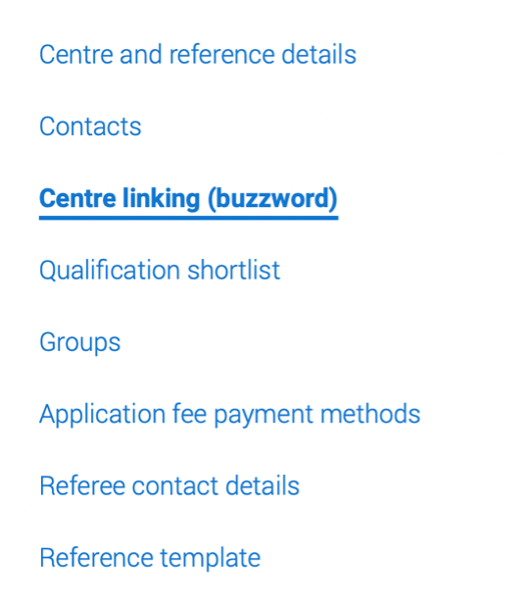
Within Centre management, find the Centre linking (buzzword) section.

Choose a buzzword that's unique to your school or organization and easy for students to enter correctly.

UCAS recommends creating a different buzzword for each application cycle to avoid confusion.

Save your buzzword once you've finished.

UCAS Centre management screen showing the centre linking and buzzword settings
Find the Centre linking (buzzword) section to create or manage your centre's buzzword.

Step 4: Share the Buzzword With Your Students

Once your centre is set up, you can give the buzzword to students applying through your school.

They'll enter it when starting their UCAS application to link their application to your centre.

If a student has already started their application, they can still request to link it using your buzzword. You'll need to accept that request through the adviser portal.

We walk students through both situations in our step-by-step guide to adding a UCAS buzzword.

A Few Things to Check Before Students Start Applying

Before you share your buzzword, take a few minutes to review your centre settings.

  • Staff access: Make sure the counselors or teachers helping students have the appropriate permissions in the adviser portal.
  • References: Confirm who will be responsible for preparing and approving each student's academic reference. Our UCAS Reference Guide for US College Counselors explains what to include and how the reference differs from a typical US recommendation letter.
  • Application fees: Decide whether students will pay their own UCAS application fees or whether your centre will handle payment.
  • Internal deadlines: Consider setting a school deadline ahead of the official UCAS deadline so there's enough time to review applications and complete references.

These are small steps, but they can save a lot of last-minute back-and-forth once students begin applying.

For more details, UCAS has an official guide to setting up your centre.

What Happens When a Student Uses Your Buzzword?

When students enter your buzzword while starting their application, they're normally linked to your centre automatically.

If they add the buzzword after starting their application, you'll receive a linking request in the adviser portal.

You can review these requests under Centre management or the Waiting to link to centre filter.

Before accepting a request, check whether the student is asking for full application support or a reference-only link. The responsibilities are different.

With a full application link, your centre is responsible for reviewing and approving the application, providing the reference, and submitting the completed application to UCAS.

A reference-only link allows your centre to provide the reference without taking responsibility for submitting the student's application.

If you're working with former students or students applying independently, that distinction is especially helpful.

You can read more in UCAS's guidance on linking applications to your centre.

Helping Your Students Through UCAS

Setting up your centre and buzzword is just the beginning. Once students are connected, you'll also be helping them understand UK course choices, application requirements, references, predicted grades, and deadlines.

And if you're used to supporting students through the Common App, some of these steps may feel quite different.

Our 2027 UCAS Guide for US College Counselors is designed to help you support students through the application process, with practical guidance for the parts that tend to be unfamiliar to US schools.

Get the 2027 UCAS Guide for US College Counselors for $27 →

UCAS Centre and Buzzword FAQs

Do I need to create a new UCAS buzzword every year?

Yes. UCAS requires centres to set up a buzzword for each new application cycle and recommends choosing a different one from previous years.

Can I change my school's buzzword after creating it?

Yes. You can change your buzzword in Centre management during the application cycle. Just make sure your staff and students know about the change.

What if a student doesn't appear in our adviser portal?

First, check that the student entered the correct buzzword for the current application cycle.

If they added it after starting their application, check the Waiting to link to centre filter. Their request may still be waiting for approval.

Can an independent education consultant register as a UCAS centre?

Yes. Independent advisers and agents can apply to become registered UCAS centres. UCAS requires a recommendation from a member university or college, along with other registration information. Check the current registration requirements before applying.

The UK Study Expert at NACAC 2026: Connecting Counselors with UK Universities

Updated November 2026

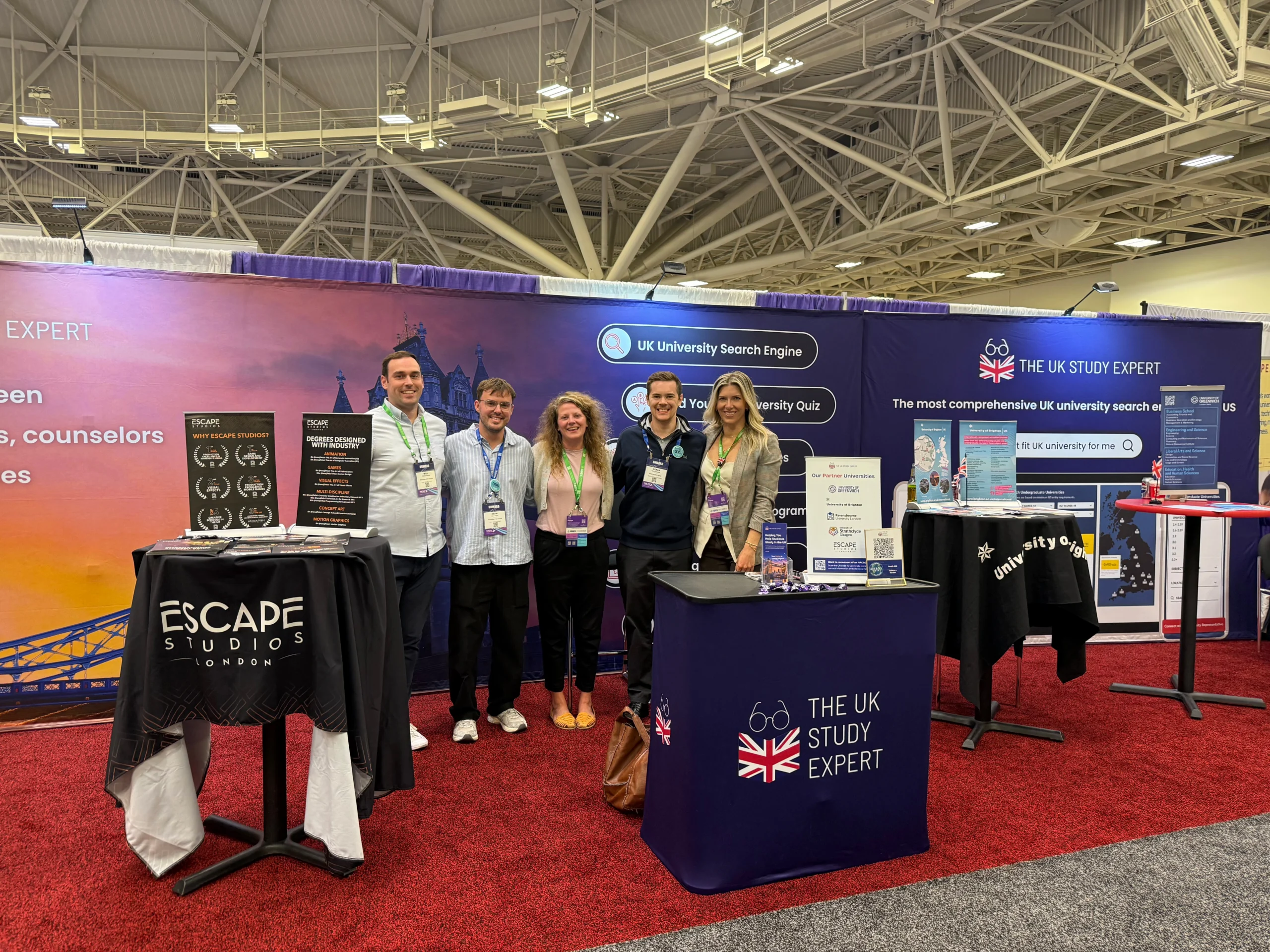
The UK Study Expert was back at the NACAC Conference this October, bringing five UK institutions to Minneapolis to connect with US college counselors.

From October 8–10, 2026, we joined counselors and university representatives at the Minneapolis Convention Center, where visitors to Booth 834 had the opportunity to meet UK university teams, explore degree options for their students, and learn more about studying in the UK.

NACAC 2026 Universities

Whether you’re just beginning to advise students interested in UK universities or you’ve been helping students apply for years, these connections are an important part of making UK higher education more accessible to US students.

Here’s a look back at NACAC 2026, the universities that joined us, and how you can continue exploring UK study opportunities throughout the year.

A Look Back at NACAC 2026

One of the things we value most about NACAC is the opportunity to bring US college counselors and UK universities together in one place.

For counselors, having direct access to university representatives means being able to ask questions, learn about different academic programs, and better understand the options available to students considering a degree in the UK.

At this year’s conference, The UK Study Expert was joined by five institutions representing a range of academic interests, university experiences, and locations across England and Scotland.

Together, we were able to introduce counselors to universities offering everything from engineering and business to animation, creative technologies, architecture, and more.

And while NACAC lasts just a few days, the connections and resources available through The UK Study Expert continue throughout the year.

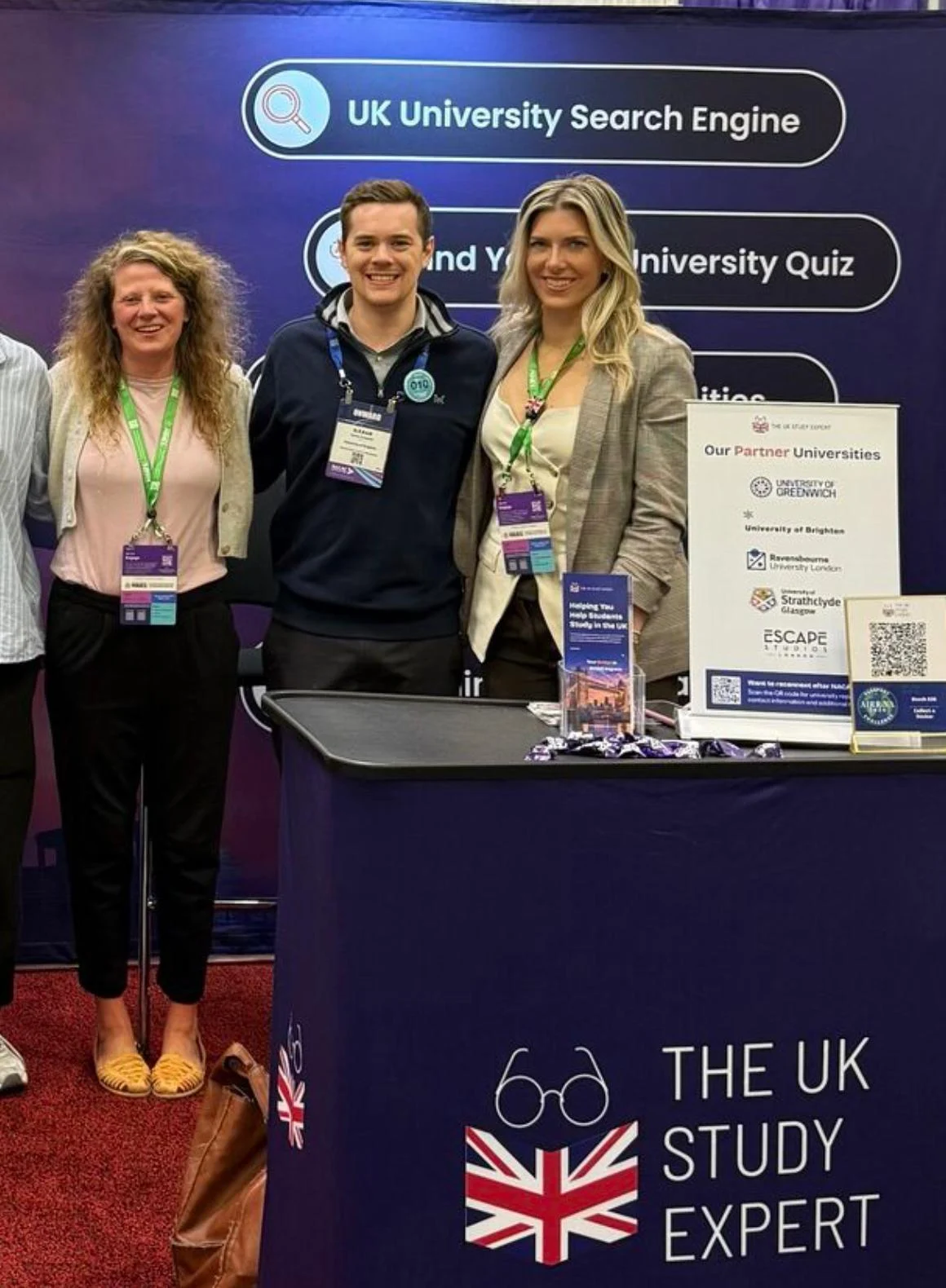
University representatives at The UK Study Expert's NACAC 2026 exhibition booth
University representatives at The UK Study Expert's NACAC 2026 exhibition booth.
Lucy Mears

Meet Lucy Mears

Associate Director, International Student Recruitment

[email protected]

Escape Studios specializes in animation, games, and visual effects, with undergraduate, postgraduate, and short courses developed with industry input. Its practical approach helps students build the creative and technical skills used in professional studios—an exciting option for students interested in the art and technology behind films, television, and video games.


University website · UKSE quick university profile

Kieran Campbell

Meet Kieran Campbell

International Officer (Europe, UKI and North America) 

[email protected]

With three campuses in Brighton, the University of Brighton offers a wide range of subjects in a coastal city setting. Students can explore art and design, architecture, business, engineering, computing, health, and education. Its breadth gives counselors plenty of opportunities to find a match for students with different academic and career interests.


University website · UKSE quick university profile

Adam Austin

Meet Adam Austin

Senior International Recruitment Officer

[email protected]

The University of Greenwich offers degrees across business, engineering, computing, architecture, creative subjects, and health. Its courses draw on connections with business and industry, helping students connect academic study with their career plans. Campus locations in London and Kent offer students a range of settings within a diverse university community.


University website · UKSE quick university profile

William Gilzean

Meet William Gilzean

Senior International Recruitment Officer

[email protected]

Located in central Glasgow, the University of Strathclyde combines its tradition of “useful learning” with a broad range of undergraduate and postgraduate degrees. Its four faculties cover Engineering, Science, Humanities and Social Sciences, and Business. Students can pursue their academic interests while experiencing life in Scotland’s largest city.


University website · UKSE quick university profile

Vusala Vaughan

Meet Vusala Vaughan

International Student Recruitment Manager

[email protected]

Based in the Design District in North Greenwich, Ravensbourne University London offers an industry-focused education within a thriving creative community. Its emphasis on creativity, business, and technology makes it an engaging option for students interested in developing ideas and applying them to professional practice.


University website · Discover Ravensbourne

The UK Study Expert at NACAC Through the Years

NACAC has become an important part of how The UK Study Expert connects US college counselors with UK universities.

Over the years, we've returned with university partners to give counselors opportunities to meet representatives, ask questions, and discover UK university options they can share with their students.

2023

Baltimore, Maryland

We exhibited alongside 14 UK university partners, connecting US counselors directly with universities across the UK.

2024

Los Angeles, California

The UK Study Expert returned to NACAC with UK university partners and resources for counselors advising students interested in studying in the UK.

2025

Columbus, Ohio

We continued bringing UK universities and US college counselors together at NACAC in Columbus.

2026

Minneapolis, Minnesota

We joined five UK institutions at Booth 834, continuing our work connecting US counselors with universities and study opportunities across the UK.

Keep Exploring UK Universities After NACAC

Didn't get a chance to stop by our booth? Or did you meet us at NACAC and want to continue learning about UK universities?

You don't have to wait until the next conference. From visiting UK universities in person to learning the ins and outs of UK admissions, here are two ways to keep exploring.

2027 UK Counselor Tours

There's only so much you can learn about a university from a website or brochure.

Our UK Counselor Tours give you the opportunity to visit universities, meet admissions teams, explore campuses, and experience different parts of the UK for yourself.

You'll come away with a better understanding of what each university offers and what studying there could look like for your students.

Upcoming 2027 tours:

  • London: March 7–13, 2027
  • Scotland: March 14–20, 2027
  • Coastal England: May 9–14, 2027

Explore the 2027 UK Counselor Tours →

UK Admissions Academy

Have students asking about UK universities, but you're not quite sure how the application process works?

The UK Admissions Academy is a virtual training experience designed for US college counselors who want to better understand UK higher education and admissions.

You'll learn about UK universities, qualifications, applications, and other topics that can help you support students considering a degree in the UK.

Resources for Counselors and Students

You can also explore UK study options and share resources with students and families throughout the year.

Our UK University Search Tool helps you explore universities and programs, while the free UK University Match Quiz helps students discover potential university matches based on their interests and preferences.

These resources can be a useful starting point when a student comes into your office and says, “I’m thinking about studying in the UK. Where should I start?”

Staying Connected Beyond NACAC

Thank you to the five UK institutions that joined us in Minneapolis and to the counselors who took the time to visit Booth 834.

We’re glad to continue creating opportunities for US counselors to learn about UK higher education and connect with universities across the UK.

If we didn’t get a chance to meet you at NACAC, we’d still love to connect.

Whether you’re interested in visiting UK universities, learning more about admissions, or finding resources for your students, explore our upcoming programs and see how The UK Study Expert can help.

Explore What’s Next With The UK Study Expert

Interested in bringing more UK university knowledge and opportunities back to your students?

Explore Our UK Counselor Programs →

And if you’re planning to attend NACAC in the future, keep an eye on this page for updates about where you’ll find us next.

How to Write a UCAS Reference: A Guide for US College Counselors

If you're a US college counselor helping a student apply to universities in the UK, knowing how to write a UCAS reference is an important part of the application process.

And if you're used to writing recommendation letters for US colleges, the UCAS reference may look a little different!

Rather than writing one traditional recommendation letter, UCAS asks referees to provide information in three sections. The goal is to give UK universities specific context about the student, their academic environment, and their preparation for the course they're applying to.

Here's what belongs in each section and what US counselors need to know before getting started.

What Is a UCAS Reference?

Most undergraduate applications to UK universities are submitted through UCAS, the Universities and Colleges Admissions Service.

The UCAS reference is the part of the application completed by someone who knows the student in an academic or professional capacity, usually a teacher, college counselor, adviser, or another appropriate referee.

Students only need one reference, and the same reference is sent to all the universities and courses included in their UCAS application.

Because universities don't see where else the student has applied, your reference should not mention a specific university.

For students applying through a school registered as a UCAS centre, the reference is completed through the UCAS adviser portal.

If your school is new to UCAS, you'll also want to learn how to create a UCAS Centre and buzzword so you can manage student applications through your school.

How Long Can a UCAS Reference Be?

UCAS allows a maximum of 4,000 characters across the complete reference, including spaces, section headings, and line breaks.

Because UCAS includes the section headings in that total, the text you enter needs to be under 3,800 characters.

There isn't a separate character limit for each section. You can decide how much space each section needs based on the information you have to provide.

And don't feel like you have to use every available character!

UCAS encourages references to be factual, specific, and concise. A shorter reference with useful information is better than filling the space with general praise.

How to Write a UCAS Reference: The Three Sections

For students whose applications are linked to a registered UCAS centre, the reference is divided into three sections.

Section 1: Information About Your School or College

The first section gives UK universities context about the student's educational environment.

For a US high school, this is a useful place to explain things that may not be immediately obvious to a UK admissions team.

For example, you might include:

  • Whether your school is public, private, charter, or another type of school
  • The curriculum and qualifications available at your school
  • Whether your school offers AP courses or other advanced coursework
  • Any restrictions on the courses students are able to take
  • Relevant information about your student population or academic environment
  • Context that helps a UK university understand your students' US qualifications
  • How your school approaches predicted grades, if relevant

This isn't meant to be a lengthy school profile. Focus on the information that will help admissions teams understand the student's academic background.

Here's something helpful: If your school is registered as a UCAS centre, you can create a reference template in the adviser portal. That way, you don't have to rewrite the same school information for every student.

Section 2: Extenuating Circumstances

This section is optional.

Use it when there are circumstances that have affected the student's education, academic performance, examinations, or assessments.

For example, a student may have experienced a significant disruption during high school that helps explain an unusual period in their academic record.

The important thing is to provide context that will help the university understand the student's educational experience.

There are two things to keep in mind:

  • Only include information that is relevant and useful to the universities reviewing the application.
  • Get the student's consent before sharing personal or sensitive circumstances, including health or disability information.

If there's nothing relevant to include, you can indicate that there's no information to enter for this section. The student won't be disadvantaged simply because there are no extenuating circumstances to report.

Section 3: Other Supportive Information About the Student

This is the section US counselors will probably find most familiar.

UCAS asks referees to provide supportive information that is specific to the student and relevant to the course or courses they're applying for.

You might include:

  • Academic performance and ability in relevant subjects
  • Particularly strong performance compared with other students in their cohort
  • Achievements on relevant projects or assessments
  • Relevant work experience
  • Transferable skills
  • Extracurricular activities that support their application
  • Evidence of the student's preparation for their chosen subject
  • Barriers the student has faced in accessing relevant work experience
  • Relevant context if the student is reapplying or has taken a gap year

If you're used to writing recommendation letters for US colleges, this format might feel a little strange at first. You're probably accustomed to sharing a student's achievements, character, and potential in a much more personal letter.

But you can still advocate for your student!

The difference is that UCAS wants specific information that helps universities understand the student's academic background and preparation for their chosen subject.

Instead of simply saying a student is exceptional, for example, give the university something specific that demonstrates their academic ability.

If the student is applying to study engineering, you might highlight their performance in advanced mathematics or physics, a relevant research project, or another experience that demonstrates their preparation for the subject.

The goal isn't to write a broad character recommendation filled with general praise. It's to provide useful, evidence-based information that adds something to the student's application.

What About Predicted Grades?

If a student has qualifications listed as pending, you may also be asked to provide predicted grades.

This is separate from the written reference itself, but it's another part of UCAS that can feel unfamiliar to US college counselors.

UCAS uses predicted grades for qualifications a student is still completing. For US applicants, what you're asked to provide will depend on the qualifications entered in the student's application.

Predicted grades should be based on your school's academic assessment and professional judgment, rather than the grades a student hopes to receive.

If you're unable to provide a predicted grade for a pending qualification, UCAS provides an option to indicate that you cannot do so.

You can read more in the official UCAS predicted grades guidance.

Should You Repeat What's in the Student's Application?

Usually, no.

UCAS recommends reviewing what the student has included in their application before finalizing the reference.

There's generally no reason to use your limited space repeating information the student has already provided unless you're adding useful context or commenting on it.

For example, if the student has already described an academic project, you don't need to summarize the entire project again. But if you supervised that work and can provide evidence about the level at which they performed, that could be helpful.

The same principle applies to the student's personal statement.

For 2027 entry, students answer three structured personal statement questions about their interest in the subject, academic preparation, and preparation outside formal education.

Your reference should add context to the application rather than duplicate it.

For more changes to the current application cycle, read our UCAS Updates for 2027 Entry.

Can You Mention a Specific UK University?

No.

The student may be applying to several universities, and each university receives the same UCAS reference without seeing the student's other choices.

Avoid statements such as, "I highly recommend Maya for the University of Edinburgh."

Instead, focus on the student's suitability for the subject or course area they're applying to.

This is particularly important for US counselors who may be accustomed to submitting separate recommendation letters to different US universities.

If you're trying to understand other differences between the two application systems, read our Common App vs. UCAS guide.

What If the Student Isn't Applying Through a UCAS Centre?

Students can also apply independently.

An independent applicant chooses a referee who knows them in an academic or professional capacity. UCAS does not allow the referee to be a family member, friend, partner, or ex-partner, and applicants cannot write their own reference.

The reference still uses three sections, but Section 1 works differently.

Instead of providing information about a school or college, an independent referee gives a brief overview of their relationship with the applicant, such as their role and how long they've known the student.

Sections 2 and 3 can then provide relevant circumstances and additional supportive information about the applicant.

If you're supporting multiple UK applicants at your school, registering as a UCAS centre can make it easier to manage student applications, references, predicted grades, and school information in one place.

You can also review the UCAS guidance for independent applicant references.

UCAS Reference Tips for US College Counselors

Before you submit a reference, keep these points in mind:

  • Be specific. Evidence is more useful than broad praise.
  • Keep it concise. You don't have to fill every available character.
  • Focus on the course. Include information that helps demonstrate the student's preparation and suitability for what they want to study.
  • Don't repeat the application. Add context or evidence rather than restating what the student has already written.
  • Don't name a university. Every UCAS choice receives the same reference.
  • Talk to the student first. Make sure you understand what they're applying to and what they've included in their application.
  • Get consent before sharing sensitive information.
  • Review everything before submission. Once an application has been sent to UCAS, the reference and predicted grades cannot be changed through the application.

The biggest adjustment for US counselors is often recognizing that a UCAS reference isn't meant to be a shorter version of a US recommendation letter.

It's there to give admissions teams specific academic and contextual information they can't get elsewhere in the application.

For additional examples and instructions, see the official UCAS reference guidance for registered centres.

Supporting a Student Through UCAS?

If you're advising US students applying to UK universities, you don't have to piece together the process from UK-focused instructions.

Our 2027 UCAS Guide for US College Counselors walks you through the application from the counselor's side, including the areas that tend to be unfamiliar when you're used to US college applications.

Use it as you support students with applications, references, predicted grades, deadlines, and the UCAS adviser process.

Get the 2027 UCAS Guide for US College Counselors for $27 →

The UK Study Expert at the NACAC Conference 2025

Booth 1535 in Columbus, Ohio!

We are thrilled to announce that The UK Study Expert will be attending the NACAC (National Association for College Admissions Counseling) Conference in Columbus, Ohio from September 18-20, 2025.


Meet us and six of our UK University representatives at Booth 1535. Discover the unique opportunities these institutions offer, learn about admissions requirements, and get personalized advice from our experts.

BIMM University is a world-renowned creative arts institution that fosters talent across music, film, performing arts, and creative technologies. With nine campuses in the UK, Ireland, and Germany, including Berlin, we offer a diverse range of English-taught bachelor’s, CertHE, and master’s programmes.


Our institution is made up of four specialist schools: BIMM Music Institute, with over 40 years of contemporary music education experience; MetFilm School, a hub for budding filmmakers; MetStudios, focused on innovation in games, animation, and VFX; and Performers College, which delivers training in dance, musical theatre, and acting. Together, they reflect the collaborative and interconnected nature of today’s creative industries.


Our lecturers are industry professionals, and we teach with state-of-the-art tools and technology, ensuring students graduate with the skills, experience, and confidence to succeed. With 10,000 students representing over 60 nationalities, BIMM University is a global creative hub, empowering the next generation to shape the future of their industries.

USA Entry Requirements

Undergraduate

  • High School Diploma with 2.5-2.8+.
  • SAT, AP or ACT test scores can also be considered.
  • Most courses require a successful audition, interview or portfolio review.

North American Contact

Lucy Mears, Head of International Recruitment and Partnerships [email protected]

Representing BIMM at NACAC Conference: Kieran Jae, Deputy Course Leader

[email protected]

Leeds Beckett University is based in Leeds, UK which is a dynamic and diverse city in the center of the UK. The population of Leeds is a little over 800,000 and prides itself in being a big city with a sense of community. It is one of the most student friendly cities in the UK. There are a wide range of opportunities to be involved on campus including joining a social club, participating in sport, volunteering, becoming a student ambassador, and more! We have 9 academic schools that offer a wide range of courses to study across multiple disciplines at both the undergraduate and postgraduate level.

USA Entry Requirements

Undergraduate

  • 3.0 Unweighed high school GPA (test optional)
  • 2 reference letters (at least one academic)
  • Personal statement

North American Contact

Alex Ukkelberg, International Development Officer  [email protected]

Students at Liverpool Hope University have the best of both worlds; living and studying on friendly, beautiful campuses while also having the advantage of being a bus ride away from one of Europe’s most vibrant and culturally rich cities.


Dating back to 1844, our students always benefit from a high-quality teaching and research environment. In 2023, we were proud to be awarded Silver in the Government’s Teaching Excellence Framework (TEF).


Liverpool Hope University is spread across two beautifully landscaped sites. Hope Park is located in the leafy suburbs of Liverpool, while our Creative Campus sits a stone’s throw away from Liverpool’s creative and cultural hubs and the buzz of a busy city centre. We have invested more than £60 million in new university buildings and facilities to support the creation of an enriched learning environment.


Our students are at the heart of our university, demonstrated by our Top 3 ranking for Student Satisfaction in the North West. (Complete University Guide 2024)

Liverpool, a city like no other, boasts world-famous architecture, magnificent museums, and a rich musical heritage that has shaped popular culture. This vibrant hub of creativity hosts spectacular festivals, thrilling sporting events, and unique art, consistently drawing millions of visitors each year. It’s no wonder that Liverpool was recognized as one of Britain’s top travel destinations (Telegraph, 2018).

USA Entry Requirements

Undergraduate

You should have a High School Diploma (Grade 12) with a GPA of 3.0 or above
with one of the following:


  • 3 Advanced Placement Exams at grade 3 or above
  • ACT with minimum score of 26
  • SATR score of 1200 including a minimum of 600 in Reading and Writing, and 600 in Maths
  • Associate Degree with a GPA of 3.0

We will also consider one years study at an American University.

North American Contact

Emily Duffy, Global Student and Partnership Officer [email protected]

Established in 1886, Royal Holloway, University of London was opened by Queen Victoria as one of the first all-women colleges in the UK. Today, we are proudly co-educational and open to students from all genders and backgrounds. Our main campus in Egham, Surrey, is just 40 minutes from central London and set within 135 acres of beautiful parkland. It is home to the iconic Founder’s Building, 25 academic departments, student residences, and a full range of support services – creating a close-knit, vibrant community. Here, students enjoy the best of both worlds: the benefits of a traditional campus experience alongside the cultural and professional opportunities of nearby London. In addition, some of our postgraduate programmes are delivered at our Central London campus in the heart of Bloomsbury, an ideal location for accessing the city’s world-class resources, networks, and attractions.


A member of the University of London, Royal Holloway has a distinguished reputation for research excellence and innovation. We are known for our strengths in the humanities, sciences, social sciences, business, and law, with research specialisms in areas such as cyber security, music, and creative writing.


Royal Holloway is home to over 12,000 students from more than 130 countries, with a strong international focus and approximately 25% of international students. Teaching is research-led and delivered by academics at the forefront of their fields, supported by modern facilities including cutting-edge laboratories, performance spaces, and a state-of-the-art modern library.


Through global research collaborations, exchange partnerships, and a commitment to fostering a diverse and inclusive learning environment, Royal Holloway equips students with a truly international outlook and the skills to succeed in a globalised world.

USA Entry Requirements

Undergraduate

Royal Holloway operates a test-flexible admissions policy. We consider a combination of qualifications (as listed below) and assess each application on a case-by-case basis, admitting students based on their academic suitability for the programme they are applying to.


Students would be eligible to study at undergraduate level by achieving the grade noted in one of the following qualifications:


  • Advanced Placement Exams (AP’s) – The standard entry requirement for applicants with American qualifications is Advanced Placement Exams. You will need grades of 3+ in at least 2 AP Exams. Some subjects require subject-specific AP’s, please review individual course pages for more information.
  • SAT – Score of 1040-1200 overall in the New SAT reasoning test + one AP with a grade 3+. Some subjects require subject-specific AP’s, please review individual course pages for more information.
  • ACT – Composite score of 21-27 in the ACT Examinations (including the ACT writing test) + one AP grade 3+.


Some subjects may require subject-specific AP’s or a higher AP exam, please review individual pages for more information. Specific grades for each course can be found on course finder and selecting “USA” under International & EU requirements.


International Baccalaureate (IB) – If you have taken the IB Diploma you will be considered for direct entry onto our undergraduate programmes. Specific grade requirements are in the course finder entry for your chosen course.


Associate Degree – Associate Degree with a GPA of at least 3.0 (year 1 entry; year 2 entry may be considered by a case by case basis).


College Board number – If you need to send us official transcripts of your standardised tests please quote Royal Holloway’s College Board number (CEEB number) 4899.


University preparation programmes – The Royal Holloway International Study Centre provides an International Foundation Year and International Year One programme, which are designed for international students who do not quite meet the requirements for an undergraduate course. These programmes will help to develop your academic and English language skills in preparation for university. Upon successful completion, you can progress to degree level study at Royal Holloway, University of London.

North American Contact

Emma Burgess, International Student Recruitment Manager (Europe and Americas)

[email protected]

Based in the Highlands and Islands of Scotland, we are a distinctive partnership of 10 independent colleges and research institutions that span both Further and Higher Education.


  • Top 10 most affordable UK universities (Complete University Guide)
  • 93% Student satisfaction
  • Highest well-being in Scotland
  • Our reputation is built on our innovative approach to learning and our distinctive research and curriculum – all enriched by the people, natural environment, economy, culture and heritage of the Highlands and Islands and its communities.
  • Scotland’s stunning landscapes are home to our 70 locations: set among mountains and forests, on islands and the mainland, in historic towns and cities, in hi-tech research parks, and in high-quality learning spaces.


Our +36,000 students regularly give us great feedback on our teaching, flexibility, support, and smaller class sizes.


The University of the Highlands and Islands (UHI) gives you the chance to do something different, something special.

USA Entry Requirements

Undergraduate

  • Test optional
  • US High School Diploma with GPA of 2.7 or above. Subject specifications may apply.
  • Marine Science – 2.8GPA and APs in 2 sciences

North American Contact

Elena Connell, Senior International Recruitment Officer [email protected]

The University of Strathclyde is Scotland’s third largest university. We are a truly global university providing cutting-edge education to more than 30,000 students from over 140 different countries around the world.


Originally founded in 1796 as a place of useful learning, we’re a leading technological University offering a wide range of fields of study.


We have over 200 undergraduate degree and a further 200 Postgraduate Degrees programs across 4 Faculties: Business (our Business School is triple accredited including AACSB), Engineering, Humanities & Social Sciences and Science.

USA Entry Requirements

Undergraduate

We have a test-flexible admissions policy for US students. We invite interested students to submit their application directly or through UCAS for their chosen course, along with their current or completed high school diploma, which we will consider with a minimum 3.0 GPA.

Candidates are invited to submit any standardized testing, and we will consider the following:


  • SAT: 1200 (600 in each component)/ ACT: 27 plus 2 AP exams with scores of 4+

OR


  • 3 AP exams with scores of 4+

Where candidates do not have access to or have not taken standardized testing, we will consider strong academic performance demonstrated within the high school diploma, for example AP or Honors classes.

Entry to some degree programmes may require the completion of AP classes or exams, or Honors classes with grades A/B in specific subjects eg Calculus and Physics for Engineering.

Please contact the academic department or International Office if you are not sure.

We do not superscore the SAT or consider the optional essay.

North American Contact

William Gilzean, Senior International Officer [email protected]

NACAC Conference 2024: Insights for UK Students and Counselors

The UK Study Expert at the NACAC Conference 2024

Join Us at Booth 336 in Los Angeles!

We are thrilled to announce that The UK Study Expert will be attending the NACAC Conference in Los Angeles. Visit us at Booth 336 to meet representatives from some of the leading UK universities. Discover the unique opportunities these institutions offer, learn about admissions requirements, and get personalized advice from our experts.

Meet Our Partner Universities

Bournemouth University
BIMM University
University of Chester
University of Plymouth

Bournemouth University

Bournemouth University 

Located on the south coast of England, Bournemouth University is situated in an area of outstanding natural beauty less than two hours from central London by train. We are a green, safe and friendly town welcoming students from many countries. Famous for its seven-mile stretch of award-winning sandy beaches, the town is also a thriving hub for a number of industries including the creative, financial and tourism sectors.

US Entry Requirements:

High School Graduation Diploma with a minimum GPA of 3.0 out of 4.0, plus at least one of the following:


  • SAT tests are accepted only on courses which does not list required or relevant subjects. Minimum combined score varies between 1200 and 1300, according to the course applied for.
  • ACT tests are accepted only on courses which does not list required or relevant subjects. Minimum combined score varies between 24 and 26, according to the course applied for.
  • Advanced Placement tests – AP tests are required on courses which list required or relevant subjects. You will need 2 or 3 tests and the required score per subject will range between 3 and 5, depending on the course applied for. Additional tests such as SAT or ACT will support your application. 
  • Some courses will require an art portfolio and/or interview.

If you apply for a course which requires AP tests but are unable to take the tests, please contact the International Admissions Team on [email protected] to discuss your options.

US Contact:

Luciana Figueiredo

Email: [email protected]


BIMM University

BIMM University

BIMM is committed to providing the highest quality in creative arts education. Their lecturers are real industry experts, actively working in the creative arts alongside teaching at BIMM, and students have access to tools, tech and equipment used by the industry today. As a student at BIMM University, you will join a real community of creatives, with opportunities to collaborate across its disciplines both inside and outside of the classroom.

US Entry Requirements:

  • High School Diploma with 2.5-2.8+.
  • SAT, AP or ACT test scores can also be considered, but not required.
  • Most courses require a successful audition, interview or portfolio review.

US Contact:
Andrew (Andy) Moss

Email: [email protected]

University of Chester

University of Chester  

Proudly welcoming over 14,000 students from 115 countries worldwide, The University of Chester provides a vibrant, diverse and safe home for students. The University is one of the oldest higher education providers in the United Kingdom having recently celebrated its 182nd year of teaching, starting off as a teacher training college back in 1839. The University now offers more than 200 single and combined honours programmes.


US Entry Requirements:

High School diploma (or equivalent) with a GPA of 2.8 and one of the following:

  • SAT overall score of 1100+
  • ACT overall score of 22+
  • 2 AP’s in relevant subjects with grades 3 or above

Some courses may require additional criteria, please contact the International Centre for clarification.

Engineering courses require an additional mark of at least 55% in a Maths module.

US Contact:
Isabella Henney
Email: [email protected] 


University of Greenwich

The University of Greenwich, London, is driven by a founding ethos of ‘no limits’. Our fundamental vision is to empower everyone to explore new possibilities, unbound by conventional wisdom and artificial boundaries. Voted by StudentCrowd as the Number 1 University in London and by WhatUni Student Choice as the Number 1 University in London for international students, the University of Greenwich is a lively and diverse community of people united by their passion for learning.

US Entry Requirements:

High School Diploma with a minimum GPA 3.2 or GED with a minimum grade of 175.

For students with a GPA 2.8 or GED of 165, you will also need ONE of the following:

  • ACT – Grade 22 or above
  • AP – Grade 3 or above in 2 advanced placement tests
  • SAT – 1050 in SAT with minimum of 500 in each section (Post-March 2016) or 1650 (pre-March 2016)

US Contact:
Adam Austin

Email: [email protected] 

University of Plymouth

University of Plymouth

The University of Plymouth is a modern city centre university located in the South West of England, nestled between the beaches of Devon and Cornwall and picturesque Dartmoor.

Ranked as one of the UK’s top 10 modern universities, it is our aim to advance knowledge and transform lives. Plymouth is committed to investing in the future of its students, fueling their career development with degrees designed to unveil strengths, to tackle global challenges and make a positive difference to people’s lives.

US Entry Requirements:

Minimum GPA of 3.0 out of 4.0 in a US High School Graduation Diploma with a minimum of one of the following: 

  • AP at grade 3, 4 or 5 (usually two or three subjects relevant to the course)
  • SAT 1050 or above
  • ACT 25 or above.

US Contact:
Andrew Rossiter

Email: [email protected]

Middlesex University

Middlesex University is a world-class centre for education, research and skills-based learning with a 130 year heritage. We offer a wide range of courses, taught by academics who are researchers or practitioners in their field and share their real life experience with their students.

Our state-of-the-art campus in Hendon, north London, is one of the biggest in the capital and means our students have everything they need in one place – including 24/7 support.

US Entry Requirements:

GPA Requirement

  • 3.2+

Test optional / not required. Some programmes may require specific subject requirements, which can be met with 2 AP exams in the subject area. A minimum of 3-4 AP tests with Grades of 5 (with specific subjects). Expected to be taken alongside a relevant high school diploma.


  • 2.8 – 3.1

SAT of 550 on each part, OR ACT composite score of 23, OR 2 AP exams with 3+


  • 2.7 or below

Can be considered for a Foundation Year. Must provide SAT of 550 on each part, OR ACT composite score of 23, OR 2 AP exams with 3+


US Contact:
Gabriela Mendez Madera

Email: [email protected] 

We look forward to seeing you at the conference and helping you explore the exciting opportunities available at these prestigious UK universities.
Don’t miss the chance to visit Booth 336 and take the first step towards an international education experience!

Dual Offers Dilemma: US vs UK Choice | The UK Study Expert


As a US student faced with the dilemma of accepting an offer from a US university for May 1 or meeting the conditional offer from a UK university in June, careful consideration and planning are crucial. Here are some professional suggestions on how to navigate this situation and make an informed decision.


  1. Consider Accepting the US Offer: Given the May 1 deadline commonly set by US universities, it may be wise to accept the US offer and secure a spot. This allows for certainty in the short term, while also providing the opportunity to explore options with the UK offer.

  2. Evaluate the Conditional Offer: US students should carefully review the conditions attached to the UK offer. Assess the likelihood of meeting these conditions, such as achieving specific grades or fulfilling other requirements, by the stipulated deadline in June. You may be able to ask your UK university if this is a hard conditional requirement. If you are just short of meeting the requirement, the US recruitment officer may be able to speak on your behalf to admissions. If you don’t meet their requirements, you can also rely on your insurance university choice as a back-up or the university may be able to provide another option, such as a Foundation Year.

  3. Explore Deferral Options: If feeling torn between the two offers, US students may want to consider deferring one of them. Some US and UK universities may offer deferral options, allowing students to postpone their admission for a year. This can provide additional time to make an informed decision and meet the conditions of the UK offer.

  4. Communicate with Universities: It’s important to keep communication lines open with both US and UK universities. Inform them about your decision, inquire about deferral options, and seek clarifications on any queries or concerns you may have. Professional and timely communication can help navigate the process smoothly.

  5. Evaluate Priorities and Goals: Reflect on your priorities and long-term goals. Consider factors such as academic programs, university reputation, location, career opportunities, and cost of education. Carefully weigh the pros and cons of studying in the US versus the UK, and how each aligns with your personal and professional aspirations.

  6. Consider Financial Implications: Evaluate the financial aspects of both offers, including tuition fees, living expenses, and available financial aid options. Factor in potential currency exchange rates and cost of living in the UK. Develop a budget and assess the financial impact of each option.


In conclusion, US students facing the decision of accepting offers from both US and UK universities should approach it strategically. By carefully considering the conditional offer, exploring deferral options, communicating with universities, and evaluating priorities and financial implications, students can make an informed decision that aligns with their academic and career goals.


How The UK Study Expert Search Tool and Quiz Can Help You


Lucky for you, the UK Study Expert has taken the guesswork out of figuring out what each university requires with our handy dandy search tool. Or you can find your best university by taking our free UK University Quiz Match.


Need to speak to an advisor about studying in the UK? Check our Services webpage to see what the best available options are for your needs. 


US & UK University Offers and Options | The UK Study Expert

Deciding where to pursue higher education is a crucial decision for students, especially when they have offers from universities in different countries. For US students who have received offers from both US and UK universities, it’s important to carefully weigh their options and make an informed decision. One of the key considerations is whether to put a deposit down and accept their US university offer for May 1, while also accepting an offer from a UK university with a conditional offer that they would need to meet in June. Let’s explore the best approach for US students facing this situation.


Understand the UK Conditional Offer System


In the UK, universities often make conditional offers to students, which means that their offer is contingent upon meeting specific conditions, such as achieving certain grades in their final exams. For US students, this may be different from what they are accustomed to, as US universities typically provide unconditional offers, meaning that students are admitted without any conditions attached.


Before making a decision, it’s important for US students to thoroughly understand the UK conditional offer system and carefully review the conditions set by the UK university. They should consider factors such as the likelihood of meeting the conditions and the potential consequences if they fail to meet them.


Consider Your Priorities and Goals


US students should reflect on their priorities and goals when making a decision between a US and UK university offer. Factors such as academic programs, reputation of the universities, location, career opportunities, and cost of education should be considered.


US universities are known for their strong programs in various fields and may offer specialized programs that align with a student’s career goals. On the other hand, UK universities are renowned for their academic excellence and may offer a different educational experience, with a focus on a more specialized curriculum in a shorter time frame.


Students should also consider the location of the universities and their preferences for living abroad. Studying in the UK may offer a unique cultural experience and an opportunity to travel and explore Europe, while studying in the US may offer a different lifestyle and cultural experience.


Evaluate Financial Considerations


Financial considerations play a significant role in decision-making for many students. US and UK universities have different tuition fees, living expenses, and financial aid options. US universities tend to have higher tuition fees and living expenses compared to UK universities. However, financial aid options may vary between universities and students should carefully review the cost of attendance for each university, including tuition, housing, transportation, and other expenses, as well as the availability of scholarships, grants, and loans.


US students should also consider the potential impact of currency exchange rates and the cost of living in the UK, as it may fluctuate during their years of study. Creating a budget and evaluating the financial implications of studying in the US versus the UK is crucial in making an informed decision.


Manage Deadlines and Keep Communication Open


US students who have received offers from both US and UK universities should be mindful of the deadlines for accepting and declining offers. The May 1 deadline is common for US universities, and students should ensure that they submit their acceptance or decline by the designated deadline to secure their spot.


For UK universities, the conditional offer typically requires meeting certain conditions by a specified deadline, which is often in June or July. US students should carefully review the conditions and ensure that they can fulfill them on time. It’s crucial to keep communication lines open with both US and UK universities, and inform them about your decision as soon as possible to avoid any misunderstandings or complications.


Consider a Strategic Plan


If a US student is torn between accepting an offer from a US university for May 1 and meeting the conditional offer from a UK university in June, they may consider deferring their offer or accepting the US offer for May 1 to insure the student meets the UK’s conditional offer. More information on this information is listed here. determining if the student meets the conditions for the UK offer. Some US universities and UK universities may allow students to defer their admission for a year, which gives them more time to make an informed decision and meet the conditions. More information on this can be found here: Dual Offers Dilemma: Strategic Decision-making for US and UK University Offers.


Degrees We Don’t Recommend Studying | The UK Study Expert

Let’s start this article by reiterating that most programs in the UK are fully accredited and recognized in the US. However, when dealing with two different countries that have two different systems, not every program is going to transfer so seamlessly.


In this article, we are going to list the programs that won’t transfer or apply easily from the UK to the US. These are the programs we don’t recommend studying in the UK with the intention of bringing your degree back to the US.


Social Work MSc


Not surprisingly, the two different social care systems in each country make it hard to transfer a UK Social Work degree to the US.


One, it’s difficult to get into a social work program in the UK (it’s highly competitive), making it hard to even break into. Two, the US requires social workers to have a degree accredited from the Council on Social Work Education (CSWE), which is a US accreditation body. Of course, UK degrees are not accredited by this body. Three, the UK’s social care system is going to be specifically tailored to the NHS, the universal healthcare system in the UK. This is quite different to the US system! If you’re wanting to be a Social Worker in the US, it’s best to stick to a US Social Work degree.


If you really want to study something related to Social Work and still be in the UK, you might consider studying Sociology, Psychology, or Counseling.


Bachelor of Education (BA Education)


While a BA Education will still be recognized as a valid degree in the US, we don’t recommend you take this degree for one main reason: curriculum for the BA Education tends to be very UK focused, making it irrelevant for students wanting to teach in the US. Furthermore, a lot of US Education degrees will have programs that combine a bachelor’s and teaching credential together, which could be a much quicker option. For this reason, staying in the US for your bachelor’s of education is a better bet.


PGCE (Teaching Certification)


To gain teaching certification in the UK, students need to study and gain a PGCE (Postgraduate Certificate in Education) after completing their bachelor’s degree. This allows students to teach in the UK, however, transferring this back to the US can be quite complicated. The inability to use a PGCE in the US has to do with the very picky state-by-state system to become a credentialed teacher in the USA. As US students are fairly aware of, even trying to use your teaching credential from state to state can be a nightmare, let alone trying to use a UK teaching credential in the US.


Instead, we recommend doing your teaching credential in the US, gaining your teaching credential in the states, and a Master of Education in the UK. A Master of Education is becoming mandatory for a lot of teachers to have, and this is a degree that transfers well between the two countries. Note that the MA Education would have an international education focus.  In addition, the MA Education is only 12 months long, which will save you time and money! The UK also offers many other education specializations that could strengthen your resume.


Master of Pharmacy (MPharm)


To become a pharmacist in the US, you’d need to have a Doctor of Pharmacy, and also make sure you complete your Advanced Pharmacy Practice Experiences (APPEs) in the US. Trying to complete these internship hours in the UK and transfer them for credit in the US would likely not be successful, and would have to be redone upon returning to the States, as well as taking licensure exams in order to practice. Since pharmacy is not a smooth transition from country to country, this is one we don’t recommend undertaking in the UK.


PhD of Clinical Psychology


While a Master of Psychology can be taken in the UK and used in the US, this is not the case for clinical psychology at the doctorate level (in order to become a licensed therapist). Much like pharmacy, above, this has to do with therapy hours that must be completed within the US to become a licensed therapist. If you are wanting to study psychology in the UK, you might consider doing a master’s, and leaving the PsyD for the US.


Master of Physical Therapy (MA Physiotherapy)


Physical Therapy can be a little tricky to bring from one country to the other, as the US has done away with master’s degrees in Physical Therapy, and instead has students go straight into a doctorate program. The American Physical Therapy Association (APTA) and your state’s licensing board would need to decide on if your degree is an equivalent to US degrees, which could be a gamble. More info on transferring a foreign degree in Physical Therapy  to the US can be found on the APTA website, here: http://www.apta.org/CareerDevelopment/ForeignEducation/.


Instead of studying Physical Therapy, you may consider Occupational Therapy (although this still has a few hoops to jump through), or Sports and Exercise Science.


Do Your Own Research


With all of these subjects, regulations are always changing, so we recommend consulting any type of accreditation board (whether it’s your state, or an independent accreditation body) in order to see what the correct route is for you. They will be your best source for seeing if a UK degree will transfer over to the US.


If you’re wondering if you have enough classes in the subject to go into Year 2, most universities will be able to provide an assessment for you before applying. You can contact them directly on our university search pages by clicking “Contact University”.


Interested in finding your best match UK university? Take our free UK University Match Quiz to learn what are your top 5 UK university matches!


If you want to ensure that you are making the right decision in the application process, our advisors can support you throughout the process and help you get into your dream UK university!


About the Author:

Ashley Jeanson is an international education expert with over 9 years of experience in the field. She’s worked for a mixture of study abroad providers, universities in the US and the UK, and third-party providers, mostly specializing in helping American students attend UK universities. In her spare time, she travels the globe and is eternally in search of the best cup of coffee. 


UK’s Finest Universities: Campus Tours | The UK Study Expert

Visiting universities in the United Kingdom is an exciting prospect for prospective students and their families. The UK is home to some of the world’s best universities, so it’s important to take the time to become familiar with the different campuses before making a decision. Whether you are considering a degree in the UK or simply want to explore the possibilities, scheduling a campus tour is the perfect way to get a better understanding of the university experience.


We understand that every university has their own procedure when conducting tours or Open Days for families to visit campus. Below we have listed information, procedures, and who to contact for each of our partner UK universities:


Northern Ireland

Queen’s University Belfast

Campus Open Day Information

Preferred method to schedule tour: Online Form. Can email directly if needed.

  • Can students meet with a faculty member? Yes – just let us know on either the booking form or by email what program(s) you’re interested in, and we can arrange it for the day.

  • Can students meet with a Student Ambassador? Yes. 

  • Can a student sit in to observe a classroom? Yes.

  • Do you provide accommodation tours? Yes.

  • Additional information: We can accommodate pretty much any request, and are happy to advise on general travel plans to Belfast and Northern Ireland.

Scotland 

University of Glasgow

Campus Open Day Information

Preferred method to schedule tour: Online Form.

  • Can students meet with a faculty member? Yes.

  • Can students meet with a Student Ambassador? Yes.

  • Can a student sit in to observe a classroom? No. 

  • Do you provide accommodation tours? Yes. Please email to schedule accommodation tour. 

University of Strathclyde

Campus Open Day Information

Preferred method to schedule tour: Online Form.

  • Can students meet with a faculty member? Yes. Email to request.

  • Can students meet with a Student Ambassador? Yes.

  • Can a student sit in to observe a classroom? No. 

  • Do you provide accommodation tours? Depends on the availability.


Wales

Aberystwyth University

Campus Open Day Information

Preferred method to schedule tour: Email.

  • Can students meet with a faculty member? Yes.

  • Can students meet with a Student Ambassador? Yes.

  • Can a student sit in to observe a classroom? No.

  • Do you provide accommodation tours? Depends on availability.

Cardiff University

Campus Open Day Information

Preferred method to schedule tour: Email.

  • Can students meet with a faculty member? Yes.

  • Can students meet with a Student Ambassador? Yes.

  • Can a student sit in to observe a classroom? No.

  • Do you provide accommodation tours? Depends on availability.

University of Wales, St. Trinity

Campus Open Day Information

Preferred method to schedule tour: Email. Online form is also available.

  • Can students meet with a faculty member? Yes.

  • Can students meet with a Student Ambassador? Yes. 

  • Can a student sit in to observe a classroom? Yes. 

  • Do you provide accommodation tours? Depends on availability.


England

Arts University Bournemouth

Campus Open Day Information

Preferred method to schedule tour: Website. Can email directly if needed.

  • Can students meet with a faculty member? Depends on availability. 

  • Can students meet with a Student Ambassador? Yes. 

  • Can a student sit in to observe a classroom? Yes.

  • Do you provide accommodation tours? Depends on availability.

Bournemouth University

Campus Open Day Information

Preferred method to schedule tour: Email.

  • Can students meet with a faculty member? Yes. Recommended to schedule six weeks in advance to schedule. 

  • Can students meet with a Student Ambassador? Yes. 

  • Can a student sit in to observe a classroom? No. 

  • Do you provide accommodation tours? No.

Falmouth University

Campus Open Day Information

Preferred method to schedule tour: Online form. Can email directly if needed.

  • Can students meet with a faculty member? Yes.

  • Can students meet with a Student Ambassador? Yes. 

  • Can a student sit in to observe a classroom? No.

  • Do you provide accommodation tours? Yes.

Goldsmiths University of London

Campus Open Day Information

Preferred method to schedule tour: Email.

  • Can students meet with a faculty member? Yes. Must be 3 weeks notice. Virtual meetings are also offered.

  • Can students meet with a Student Ambassador? Yes. 

  • Can a student sit in to observe a classroom? Yes.

  • Do you provide accommodation tours? Depends on availability.

Imperial College London

Campus Open Day Information

Preferred method to schedule tour: Online form. Can email directly if options aren’t available.

  • Can students meet with a faculty member? Not normally but if interested, students will need to reach the department directly. 

  • Can students meet with a Student Ambassador? Yes. 

  • Can a student sit in to observe a classroom? No. 

  • Do you provide accommodation tours? No.

King’s College London

Campus Open Day Information

Preferred method to schedule tour: Online form.

  • Can students meet with a faculty member? No.

  • Can students meet with a Student Ambassador? Yes. 

  • Can a student sit in to observe a classroom? No.

  • Do you provide accommodation tours? Yes. Please email to schedule a tour. 

Lancaster University

Campus Open Day Information

Preferred method to schedule tour: Email.

  • Can students meet with a faculty member? Yes.

  • Can students meet with a Student Ambassador? Yes. 

  • Can a student sit in to observe a classroom? No. 

  • Do you provide accommodation tours? Depends on availability.

Leeds Arts University

Campus Open Day Information

Preferred method to schedule tour: Email.

  • Can students meet with a faculty member? Yes.

  • Can students meet with a Student Ambassador? Yes. 

  • Can a student sit in to observe a classroom? Yes. 

  • Do you provide accommodation tours? Yes.


London Metropolitan University

Campus Open Day Information

Preferred method to schedule tour: Email.

  • Can students meet with a faculty member? Yes.

  • Can students meet with a Student Ambassador? Yes. 

  • Can a student sit in to observe a classroom? No. 

  • Do you provide accommodation tours? No. 


Loughborough University

Campus Open Day Information & Experience Days

Preferred method to schedule tour: Email.

  • Can students meet with a faculty member? Yes.

  • Can students meet with a Student Ambassador? Yes. 

  • Can a student sit in to observe a classroom? No. 

  • Do you provide accommodation tours? No.


Middlesex University London

Campus Open Day Information

Preferred method to schedule tour: Online form. Can email directly if needed.

  • Can students meet with a faculty member? Yes, depending on availability.

  • Can students meet with a Student Ambassador? Yes.

  • Can a student sit in to observe a classroom? No. 

  • Do you provide accommodation tours? Yes.

Ravensbourne University

Campus Open Day Information

Preferred method to schedule tour: Online form. Can email directly if needed.

  • Can students meet with a faculty member? Depends on the availability.

  • Can students meet with a Student Ambassador? Depends on the availability.

  • Can a student sit in to observe a classroom? No.

  • Do you provide accommodation tours? No.

Royal Holloway, University of London 

Campus Open Day Information

Preferred method to schedule tour: Online form. Can email directly if needed.

  • Can students meet with a faculty member? Depends on the availability.

  • Can students meet with a Student Ambassador? Yes.

  • Can a student sit in to observe a classroom? No.

  • Do you provide accommodation tours? Yes, depending on availability.

  • Additional Information – Staying the night? RHUL has affordable accommodation for guests. Book here. 


University of Birmingham

Campus Open Day Information

Preferred method to schedule tour: Online form. Can email directly if needed.

  • Can students meet with a faculty member? Yes, please request this with the America’s team. 

  • Can students meet with a Student Ambassador? Yes. 

  • Can a student sit in to observe a classroom? No.

  • Do you provide accommodation tours? Yes.

University of Chester

Campus Open Day Information

Preferred method to schedule tour: Email. Students can also fill in an online form.

  • Can students meet with a faculty member? Yes.

  • Can students meet with a Student Ambassador? Yes. 

  • Can a student sit in to observe a classroom? No.

  • Do you provide accommodation tours? Yes.

University of Kent

Campus Open Day Information

Preferred method to schedule tour: Online form.

  • Can students meet with a faculty member? Depends on availability

  • Can students meet with a Student Ambassador? Depends on availability.

  • Can a student sit in to observe a classroom? No. 

  • Do you provide accommodation tours? Depends on the availability.

University of Liverpool

Campus Open Day Information

Preferred method to schedule tour: Online form. Can email directly if needed.

  • Can students meet with a faculty member? Yes. Will need to be requested via email.

  • Can students meet with a Student Ambassador? Yes. 

  • Can a student sit in to observe a classroom? No. 

  • Do you provide accommodation tours? Depends on the availability.

  • Additional Information – Families can also reach Caroline for assistance. 

University of Plymouth

Campus Open Day Information

Preferred method to schedule tour: Email. Online form also available.

  • Can students meet with a faculty member? Yes. 

  • Can students meet with a Student Ambassador? Yes. 

  • Can a student sit in to observe a classroom? No. 

  • Do you provide accommodation tours? Depends on the availability.


University of Roehampton, London

Campus Open Day Information

Preferred method to schedule tour: Online form. Can email directly if needed.

  • Can students meet with a faculty member? Would need to be pre-arranged. Please Email.

  • Can students meet with a Student Ambassador? Yes.

  • Can a student sit in to observe a classroom? No. 

  • Do you provide accommodation tours? No.


University of Surrey

Campus Open Day Information

Preferred method to schedule tour: Email. Online form also available.

  • Can students meet with a faculty member? Yes. Subject to availability. Must include requests in email. 

  • Can students meet with a Student Ambassador? Yes. Subject to availability.

  • Can a student sit in to observe a classroom? No. 

  • Do you provide accommodation tours? Depends on the availability.


University of Sussex

Campus Open Day Information

Preferred method to schedule tour: Email.

  • Can students meet with a faculty member? Yes, subject to availability. Request in email

  • Can students meet with a Student Ambassador? Yes. 

  • Can a student sit in to observe a classroom? No. 

  • Do you provide accommodation tours? No.


If you have any issues reaching out to one of our partner universities listed above, please email [email protected] to connect you.