
Study: British Pound Drops vs US Dollar | UK Study Expert

Due to the recent changes from the British government on tax cuts and borrowing, the British Pound (GBP) has weakened to $0.92 per US Dollar (USD). Never has the US Dollar been so strong against the Pound.


Even before the Pound dropped, you might be surprised to know that the UK has always been a more affordable option to earn a degree compared to the US.


The average cost of tuition fees for students studying in the US on campus is $35,500 per year (Best Colleges, 2022). UK university tuition fees can range from £14,000-£26,000 per year. Not only are tuition fees far less in the UK, UK degrees in England, Wales, and Northern Ireland offer 3 year bachelor degrees (unless it’s an integrated or placement year degree). Therefore, students save an additional year of tuition and living expenses.


This also rings true to master’s degrees in the UK. A master’s degree in the UK is 12 months long. This allows the student to save another year of tuition and living expenses.


As for living expenses, if you are living in London and are on a 9 month course (degree), the UK Government recommends students applying for their UK Student Visa must have at least £12,006 to cover housing, food and transportation (not just room and board). For students living outside of London for a 9 month course, it is recommended having at least £9,207.


So if you’re looking at affordable UK degree options, you could earn your bachelor’s and master’s degrees in 4 years and save 2 years worth of tuition and living expenses!


Currency Conversion – Total Cost to Earn Your UK Degree


Now let’s convert those currency figures (GBP) to dollars (USD) in today’s economy…


If we looked at the lowest amount for UK undergraduate tuition fees (£14,000) and living fees outside of London (£9,207), the student would be looking at total expenses of £23,207 per year.


UK tuition fees and living expenses per year for a student living outside of London could be as low as $25,000 per year (xe.com, Sept 28, 2022).


If we looked at the highest amount for UK undergraduate tuition fees (£26,000) and living inside of London (£12,006), the student would be looking at total expenses of £38,006 per year.


UK tuition fees and living expenses per year for a student living inside of London could be as high as $41,000 per year (xe.com, Sept 28, 2022).


Is this the time to be looking at earning your degree in the UK more than ever? Is the pound expected to jump back and rise?


We can’t predict the future but from what we’ve read, it looks positive for Americans. The US dollar has strengthened and played a contributing factor. Economics have also pointed out that they don’t see the pound jumping back up anytime soon. The Washington Post interviewed Barry Eichengreen, a professor of economics at the University of California at Berkeley, who said “Recovery is not on the horizon” for the foreseeable future.


How Can I Start My Search and Find the Right UK University Match for Me?


There’s two main resources students can look to find the right UK University fit…

Students can start by taking The UK Study Expert UK University Match Quiz which asks you questions about what degree you are interested in applying to (undergraduate or graduate), your interests, and academic profile. The quiz will then populate the top 5 UK universities that best match your profile.

The UK Study Expert also has an Undergraduate UK University Search Engine and Postgraduate UK University Search Engine. Students can input their GPA, SAT scores, ACT scores, how many AP exams they have taken/will take, subject interest, and more. They can input as much information or as little of their academic profile and interests. Once added, the search engine will populate UK university options that match their interests and entry requirements.


UK universities have clear, transparent information for students to be admitted into their universities. They favor academics rather than looking at a holistic review of a student’s profile. To find out their US entry requirements, students can click on any of The UK Study Expert UK university pages to find out their US entry requirements.

 

How to Add a UCAS Buzzword | The UK Study Expert Guide

You might have heard some “buzz” around the UCAS buzzword (sorry, dumb joke), and you might be thinking to yourself, “why should I add the buzzword to my UCAS application?”


Here we are going to breakdown the purpose for the buzzword, and the way to add it to your application, for both students and school college counselors.


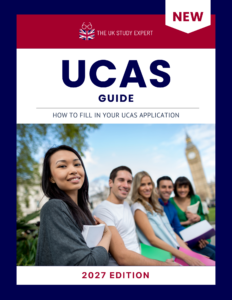
Need help with your UCAS application? Get our UCAS Guide for $27


Why Should I Add a UCAS Buzzword to My UCAS Application?


Let me first point out that adding a UCAS buzzword is not mandatory to add to a student’s application. If you don’t add a buzzword to your application, you will be considered an independent applicant.


If you find out your school or organization has a buzzword after creating your UCAS application, you can always add it in later. Just make sure you add it in before you submit your application!


The purpose of the UCAS buzzword is quite simple – it links a student’s UCAS application to a school or organization. This makes it so the school, or the organization, working with the student can easily see the application from the UCAS Advisor Portal.


If you are a student, this means you can have your counselor can view and help support you with your application without sharing your password, protecting your privacy.


If you are a school counselor, this makes it very easy to upload the student’s reference letter, as well as provide predicted grades to universities (predicted grades are sometimes asked for by UK universities), all through the UCAS Advisor Portal. You’re also able to see how many students have applied to UK universities from your school.

Ultimately, this makes the process more streamlined without as much back and forth with universities via email after applying.


The UK Study Expert has a UCAS Buzzword


Please complete the following form and let us know you’d like your application added to our system. We will reach you in 1-2 business days. A small fee may apply. For 2025 applicants, please use buzzword: ukstudyexpert25. A small fee is required for this service. 


For Students: How to Link to an Organization/School with a UCAS Buzzword


First, make sure to ask the organization/school you’re wanting to link to what their buzzword is so you have that handy. Once you create your UCAS application, you will come to a series of questions that ask:


UCAS Application


Press the ‘Yes’ button, then continue to the next question:


UCAS Buzzword


Press continue, and you’ll finally enter the buzzword here and hit ‘Save Buzzword.’


UCAS Buzzword


After adding the buzzword, let the school/organization know you’ve requested to link your UCAS via buzzword. They will then go into the UCAS Advisor Portal to approve the request. You’re now linked!


If you’ve already started your UCAS application, you can still link your application to a school or organization using a UCAS buzzword. You’ll sign into your UCAS Hub to do so, then click on your application:


UCAS Application


You’ll be taken to your application status dashboard, where you can click on the ‘Add buzzword’ button the left side:


UCAS Profile


Again, make sure to let your school or organization know you have requested to link via buzzword so they can go in and approve your request. You are then all set!


———————————————————————-


Need help figuring out your UCAS application?


Check out our step-by-step UCAS Guide! Get the UCAS Guide for $27


About the Author:

Ashley Jeanson is an international education expert with over 9 years of experience in the field. She’s worked for a mixture of study abroad providers, universities in the US and the UK, and third-party providers, mostly specializing in helping American students attend UK universities. In her spare time, she travels the globe and is eternally in search of the best cup of coffee.

How to Create a Centre & UCAS Buzzword | The UK Study Expert

For College Counselors and Independent Education Consultants Only:


Before we dive in, there’s two things you should know about the UCAS buzzword:


  1. Adding a UCAS buzzword is not mandatory. If a student doesn’t add a buzzword to their application, they will be considered an independent applicant.

  2. The student can add a buzzword midway through their application.


? Need help with your UCAS application? Get our UCAS Guide for $27


Creating a Buzzword


If your school or organization is interested in creating a buzzword, there’s a few things you should know before starting the process:


  • You must become a UCAS centre first before you can create a buzzword

  • If you are an IEC (Independent Education Consultant) and have an organization, you must provide a reference letter from a university to support your UCAS centre submission. This could take weeks to process unless you are buddy buddy with a university representative.

  • You can choose to pay for your student’s applications at the end. This could be helpful if you are working with students who might be applying at the last minute and come to find out that their credit card won’t take international payments.


First thing you’ll do is register your school as a Centre on UCAS. You can do this on this page: https://www.ucas.com/corporate/eu-and-international-schoolscentres


After that is set up, you can create your UCAS Buzzword. You’ll sign into UCAS and go to your Advisor Dashboard:


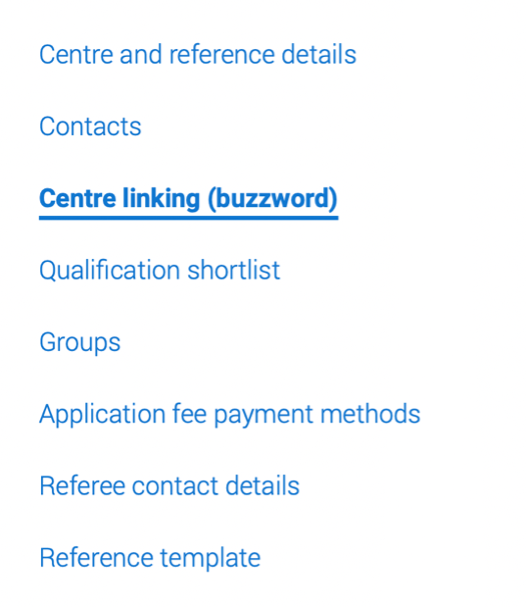
You’ll then click on the right year in the Centre Management section, where you’ll see these categories:


Here you will see ‘Centre linking (buzzword)’ and this is where you can create and save your buzzword! You’re then ready to give out your buzzword to students when asked for.


Ultimately, linking a UCAS application to a school/organization is a quick and efficient way to help support students in their UCAS applications. We hope the above information is useful and helpful in your journey to applying (or helping a student apply) to UK universities.


For more information, check out the UCAS website on how to manage applications as a UCAS centre.


Need help figuring out your UCAS application? Check out our step-by-step UCAS Guide! Get the UCAS Guide for $27


About the Author:

Ashley Jeanson is an international education expert with over 9 years of experience in the field. She’s worked for a mixture of study abroad providers, universities in the US and the UK, and third-party providers, mostly specializing in helping American students attend UK universities. In her spare time, she travels the globe and is eternally in search of the best cup of coffee. 

Joint, Single & Combined Degrees Guide | The UK Study Expert

While searching international universities can be a bit overwhelming with the different application processes, it doesn’t help when bachelor’s degrees are written in ways that you may not be familiar with.


In the UK, as opposed to the USA, universities do not allow much flexibility to study outside of your chosen course (degree) as your modules (classes) are set. For instance, if you were to study History, you would find it hard to be able to take a Biology class. While this is great for those wanting to avoid pre-requisite classes that are typically found in the US university system, it can make students feel a bit trapped. Never fear, there are some courses that do allow students to study more than one subject. In this blog. Below, we list the different types of degrees you can choose to when searching and applying to UK universities. The following are various UK degree options a student can expect.


Please note, this is not representative of all universities – you should always contact a representative of the university you are interested in to discuss your degree options. This article mainly refers to universities in England, Wales, and Northern Ireland.


Single Honours Degrees

A single honours degree is the traditional degree from a UK university. This will be specific in your course and will typically take three years. Most universities will have the class listings for the degree on the course page under a modules tab. This type of degree will be very focused on your chosen subject area and does not allow much opportunity for students to study outside of their subject area. Your classes each year will be from a select list of modules with some being compulsory modules and others being optional modules, which you must choose a number to take.


Joint Honours or Combined Degrees

A joint degree is a degree that is typically a combination of two degrees. These are also referred to as combined degrees. This would give you a diploma in both chosen subjects. The subjects must be closely related, for instance, History and International Politics may be together as a joint honours degree. While it allows you to achieve accreditation in both subject areas, you will not have the opportunity to study much outside of the two areas. Your classes each year will be from a select list of modules with some being compulsory and others being optional.  You must choose a number of modules to take for the semester.  Universities will have these joint degrees listed on their course pages and will typically not have any additional entry requirements for these degrees.


If you are interested in joint or combination courses, Aberystwyth University has a variety of different subjects you can choose from. You can visit our website to check out our list of degrees here.


Integrated Degrees

While each university may call this something different, this is a degree that may take longer than the traditional 3 years a student can expect to study at the undergraduate level in the UK. This may be a degree that is 4 years with the third year serving as an integrated year abroad or integrated year in industry. This means that for that third year you are either studying at another university, in another country, or you are obtaining work experience in the UK or abroad, depending on the options available at your chosen university.


For many students, this four-year course is the only option that allows students to study abroad for a full year. The three-year course would only allow for a semester or a summer program. If you are interested in any of your university’s 4-year integrated courses I would recommend applying for that course and then, if you change your mind later, you can move to the three-year course. Due to visa regulations, it is easier to change from a 4-year student visa to a 3 year than it is to change from a 3 year to a 4-year student visa.


You may also see degrees that are 4 years and are integrated Master’s degrees. This would give you your Bachelor’s accreditation after 3 years but you would automatically be enrolled for the Master’s level course in the subject and after 1 more year you would graduate with your Master’s as well.


No matter what subject you are interested in, you should see what different types of degrees your department or university offers. You never know, you may be able to gain practical work experience or enjoy a year abroad as part of your degree. As always, you should contact a representative of the university you are interested in to discuss your degree options as some may have differing entry requirements.


Jackie Jarocki is a Regional Officer at Aberystwyth University. Jackie is a former international student from the USA who came to study in the UK in 2018 and never left! She has been working in the UK Higher Education in international student recruitment since 2019.


What Is Clearing? A Complete Guide | The UK Study Expert

Clearing can be confusing and stressful, but it does not need to be. It is an opportunity for you to still get a place at the university of your choice during the Summer prior to September entry start!


What is Clearing?

Clearing is a system offered by UCAS, which is a UK based organization that helps you to apply for study in the UK. Clearing opens on 5 July 2022, after which point all applications made automatically go into Clearing. There is a myth that clearing only offers courses that no-one wants but that is not true. Lots of highly popular courses are still available. Each university will publish a list of courses available on the website, that will allow you to review each course and decide what you would like to study, then you can contact the university. If you have already made an application through UCAS, please keep your UCAS ID number handy with your academic results and your contact information when speaking to the universities.


The great benefit of this is you can receive guidance on how to apply, support with university information, qualification acceptance and equivalencies. UCAS is there to help you figure out what the next step in your education might be, and to support you when you take that step.


Why Apply through Clearing?

This process can support you if:


  • you already applied through UCAS and have not yet received an offer (or none you wanted to accept)

  • hold a conditional offer but have not met the required grades

  • declined their offers

  • you’re applying after June 30th


How to Apply

As an international applicant wanting to apply to a university in the UK, you will first need to contact the university directly to make sure that the degree is still available before submitting your choice on UCAS. Each university will have a dedicated clearing support team available from the 5th of July to answer all your questions. It’s easier to call them. If calling isn’t an option, you can email your US university manager or officer to assist you through the process. Don’t forget to ask if they have available housing for international students on campus too. After speaking with them, they will work to provide you with a decision on your clearing application as quickly as possible.


Once you have permission from the university, then they will give you instructions on adding the degree to your UCAS application. You will select ‘Add Clearing Choice’ with the course details by the date the university/college gave you on the phone. You can only choose one degree/university and this will count as you accepting their offer. It’s important to do a thorough research of degrees and universities prior to accepting.


So, consider joining a university with rich academic heritage, that is thought provoking and challenges thinking, whilst also been part of a close-knit community.


Below is a link to further information on Clearing for International applicants:


International students and Clearing | Goldsmiths, University of London


My name is Nicola and I’m an International Recruitment Manager for Goldsmiths, University of London. My job is to support students and agents with applying to the University as well as been a supportive member of the International recruitment team. My main area of responsibility is the Americas and I am keen to promote the fantastic reputation of Goldsmiths University of London to potential students.


UK Test-Optional and Test-Flexible

Standardized testing has always been a substantial requirement for UK undergraduate university admissions. This is due to their UK education system and their entry requirements for UK students. In our article Deciphering the High School System – US vs. the UK, UK students do not study a broad curriculum during high school like the US. Students focus on specific subjects as early as Year 10 (14 years old) and have to take those specific exams at the end of their course. These final year exams determine whether they are admitted into university.


When the pandemic occurred, many universities had to reevaluate their admissions policies on testing due to student’s safety and accessibility. UK universities haven’t fully gone completely test-optional, but most have become test-flexible. What is test-flexible? Test-flexible allows students to choose a variety of tests or classes to support their academic profile to be admitted into university.


Here is an example of what test-flexible means in the UK:


Pre-COVID example: AP exams + (ACT or SAT) + GPA

Post-COVID entry requirements: (AP exams and/or college level classes or honours level classes) + GPA. SAT/ACT not required or optional.


It’s kind of like trying to figure out a puzzle, right? We recommend first laying out what exams/classes a student will take and then go from there.


Just remember:


  • AP exams are equivalent to UK high school exams (A Levels). Most universities will require these or will accept college level courses in lieu of AP exams. Some will accept honours level classes but not all.

  • ACT/SAT – optional to provide in most university cases as long as you have AP’s or college level classes.


TIP: When searching for a specific programme, make sure to check if they require a specific AP exam for that subject. Many universities will require AP exams for specific degrees to show you are proficient in the subject. STEM is always likely to require subject specific exams, even if the university does not require them.


Are you a student interested in knowing your top UK university matches based on what exams you will be taking? Try our free UK university quiz to learn more! Free UK University Quiz


You can also use our free UK search engine HERE to select which exams you will be taking to narrow your search. Or you can click on each university profile to learn more about their transparent entry admissions criteria.


If you want to ensure that you are making the right decision in the application process, our advisors can support you throughout the process and help you get into your dream UK university!


UK Universities & the NACAC Conference

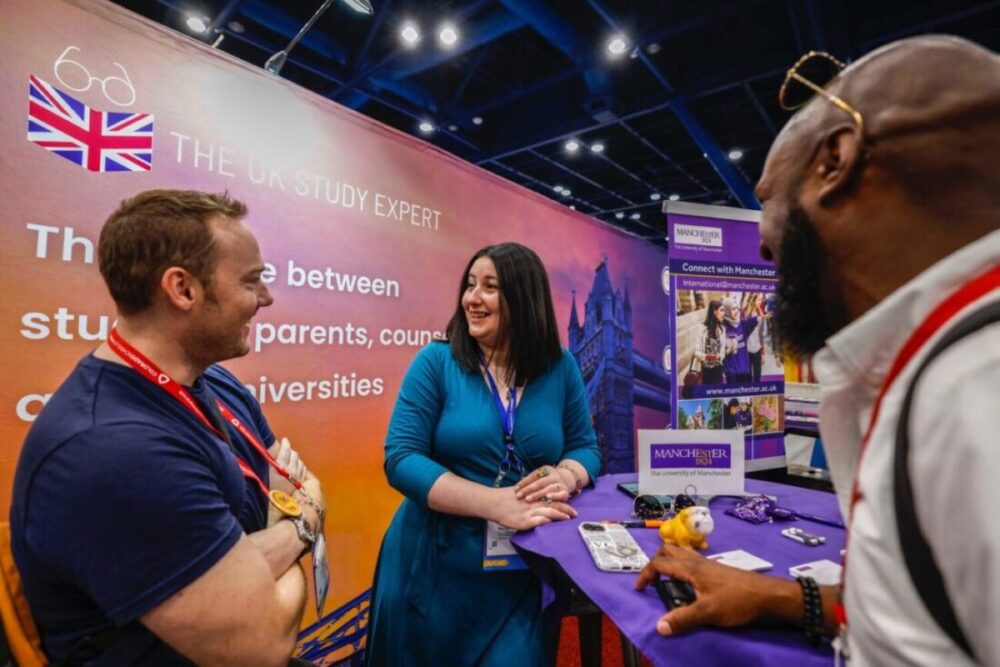
Have you attended the NACAC Conference in Houston, TX but didn’t get a chance to speak to our UK university reps? We have provided the list below:


The UK Study Expert NACAC Exhibitor Booth


University of Birmingham – Katy Friend – [email protected]

Loughborough University – Ben Daly & Simon Foster – [email protected]

University of Plymouth – Joshua Burt – [email protected]

The University of Manchester – Raluca Pasare – [email protected]

Middlesex University London – Gabriela Mendez Madera – [email protected]

London Metropolitan University – Meghan Godding & Keyan Zhu – [email protected]


The UK Study Expert NACAC Reception Additional Reps:


University of Roehampton – Haley Drogus – [email protected]

Imperial College– Catherine Eames – [email protected]

University of Bristol – Gary Coulter – [email protected]

King’s College London – Paulina Rozynska – [email protected]


Study Creative Writing in the UK | The UK Study Expert

Why study creative writing in the UK? (And why Falmouth University in particular?)


If you’re looking ahead to university and considering what you might want to study, and where, you might not have considered creative writing as a major yet. That’s not surprising: it’s not usually taught as a separate academic subject in secondary schools (high school). It’s usually taught as part of your language studies, which for many US students means it’s a (fun, one hopes) component of English class if that is the language of instruction. Let’s take a look at how it’s taught, how it’s taught in British universities, and what’s unique about our program(s) at Falmouth.


Maybe you’ve heard the myth that creative writing can’t be taught. Of course it can be, but how does it actually work? The workshop is the basic model of creative writing instruction at universities. The goal of the workshop is to recreate for the student writer how a reader will react to their work. In the real world the author isn’t there to explain their intentions. The written text has to stand on its own. Thus, in the workshop, the students will be guided through a peer-review process—sometimes a very intensive one—to offer feedback. Typically, only one or two students will have their work critiqued in a given session; the instructor will set up a rota or schedule for that. This is done in a focused way, often paired with readings in order to highlight specific skills and techniques, and to assess how well the student writer has utilized them. These may include story or poem structure, different literary forms, language mechanics (grammar, sentence structure, punctuation), description, character development, genre, dialogue, and much more. Does the story make sense, or does it contradict itself? Is it immersive, or is it just a casual, bare-bones telling of what happened? Are there gaps in the logic? Are the sentences clear and well constructed? Or is the writer trying too hard to write Really Beautiful Prose?


The biggest difference between UK and US programs, other than duration (3 years in England, Wales, and Northern Ireland vs 4 years in the US), is the British focus on industry and outcomes. Although both countries are broadly similar in their methodologies, Britain’s universities have a legal mandate to look at employment applicability. (This is why every UK university program website you look at will have some text telling you how the course might be useful preparation for certain types of jobs.) With this in mind, the classes (modules) comprising the degree will focus on craft and on readings, but there will also be coverage of, for example, the publishing industry and how it works. Like the US, many UK writing programs host literary journals and events, but the UK arguably has a stronger reading culture. Literature is still more valued here, and there is more visible government support for the arts in general. Moreover, the UK’s relative compactness means that literary events, festivals, and so forth are unlikely to be too far away.


Why Falmouth University, then? Despite being an arts university, Falmouth also has a strong culture of entrepreneurship. Our creative writing programs feature two modules on the publishing industry during year one, and another module focuses on the practicalities of being a writer. This means you will finish the year knowing how to select appropriate markets for your work, how to submit it, and how the publishing industry actually works—from the manuscript stage through to the printed book or the online literary journal you might read. There is the expected focus on craft, but you’ll also graduate knowing what to do with it.


A secondary benefit is the size of the program: it’s just large enough to allow us to run choices of modules, and it’s large enough for students to find their own groups of friends, but it’s small enough that the lecturers are able to offer 1:1 support and guidance. Everyone on the faculty is also a working writer, and a few also run (or have run) presses. Also, the Woodlane campus (now known as the Falmouth campus where the program is housed) is ridiculously pretty and six blocks from the beach. There’s the Lighthouse, a comfortable lounge and events space where students can hang out and work between classes—and, crucially, form community. Falmouth is unique among UK universities in that it has its own personality and guiding philosophy, and it isn’t afraid to do its own thing. If you’d like to know more about the program, please get in touch. Someone from the department would be more than happy to have a chat with you.


Dr. Marshall Moore is Course Leader (BA Hons, English & Creative Writing) and Senior Lecturer in the School of Communication at Falmouth University. He holds an MA in applied linguistics from the University of New England (Australia) and a PhD in creative writing from Aberystwyth University. His research interests include the pedagogy of creative writing and the disconnects between the academy and the publishing trade. Recent and forthcoming books include two academic collections: The Place and the Writer: International Intersections of Teacher Lore and Creative Writing Pedagogy (Bloomsbury, 2021) and Creative Writing Scholars on the Publishing Trade: Practice, Praxis, Print (Routledge, 2022). His memoir I Wouldn’t Normally Do This Kind of Thing will be published by Rebel Satori Press in 2022.

Degrees in Scotland

Have you ever wondered, what the differences are from Scottish degrees compared to English, Welsh and Northern Irish degrees? Ashley Warmington from University of Glasgow explains:

There are four nations within the UK;  England, Northern Ireland, Wales, and Scotland. The education system is mostly similar across the UK, but as students progress into high school, Scotland has a different degree structure than the rest of the UK.

Part of the appeal of earning a degree in the UK is the absence of general education or core curriculum requirements. Students apply directly to their major and study it from day one. This degree structure is fantastic for a student who knows what they want. But what about for those who don’t?

Scottish degrees are typically four years in length and are designed to offer breadth and depth in studies. In Scotland, students have a great deal of flexibility and choice in their first two years of study. While students will still study their chosen major right away, they will also study two or sometimes three subjects of their choosing from outside of their major. These are often referred to as Enhanced Study options.

Enhanced Study options are a great way for students to explore other interest areas or elevate their understanding of their major by engaging with other disciplines. Whether you want to heighten your employability by taking a language alongside your studies or maybe you want to take a subject you were torn between when you chose your major, you can use the subjects you study outside of your major to have a truly tailored degree experience. Another benefit of enhanced study options is that students can switch their major to any subject they have studied from year one. For instance, if you are an English Literature major you might like to study History and a Language alongside your major in first year. As you progress to second year maybe you’ve discovered you much prefer History – the Scottish degree structure allows you to change.

While this isn’t quite for the student who really has no idea what they want to specialize in, the Scottish degree does offer focused flexibility that allows for wiggle room as you grow and discover your academic interests during your studies. It is common for students in Scotland to drop or pick up a joint major, choose a minor in year 3 or change their degree altogether to a subject they have been studying since year one.

There are some restrictions when it comes to what you can study outside of your major. Firstly, you will need to meet the pre-requisites of any subject. Secondly, there can’t be any timetable clashes with your major. Lastly, some courses such as Medicine or other professional degrees might not have the same flexible options.

Overall, the Scottish degree structure is a fantastic springboard for students who want to have control over what they study and the flexibility to change specialisms.

Ashley Warmington is the Senior International Officer for western USA at the University of Glasgow. Ashley studied her undergraduate degree in Scotland and has worked in UK admissions since 2016. She is now based in Southern California, where she helps American students through the UK application process.

How to Apply for a UK Student Visa

If you’re currently ripping your hair out over the sheer amount of confusion from the UK student visa application process, then you’ve come to the right place.


Here, we are going to break down and simplify the steps for applying for a UK Student Visa to study at UK universities. This article is specifically for US students applying for a UK Student Visa, also known as the Tier 4 Visa.


Let’s start with the basics. There are a few things you need to have before you begin the visa application process.


The 4 Things Needed Before You Begin the Visa Application Process


1.     An unconditional offer from a UK university, which you’ve accepted and paid your deposit for.

2.     You have your proof of funds taken care of, which just means that you know how you’re paying for university, and you have a document to prove it. Either, you’ll be using savings (or your parent’s savings), or FAFSA/Private Loans, or a mixture of both to provide proof of funds.

3.     A CAS Statement from that university. CAS stands for Confirmation of Acceptance for Studies. The CAS statement will be sent to you via email from the university after you complete step number 1 and, in some cases, 2.

4.     A valid passport, of course! If your passport is close to expiring, you should consider renewing it before applying for the Tier 4 Visa.


When to Apply for Your Visa

You can apply for your visa when you are within 6 months from your program’s start date. If you try to apply any further out than that, your visa will be rejected. For example, if your program starts in September, the earliest you can apply is March. Once you are within the 6-month window, and you have all the required items mentioned in the ‘The 4 Things Needed Before You Begin the Visa Application Process’ section, you are all set to apply.


Where to Apply for a UK Tier 4 Student Visa

The official site to apply for a UK Tier 4 Student Visa is on the UK government website, called gov.uk. Here is the link where you can apply for the visa.


How Much Does the Visa Cost?

The cost of the visa actually depends on the length of your program. The current visa application fee is £363, but may go up at any point at the discretion of the Home Office, who is the governing body overseeing visas. In addition to the application fee, you must pay a health surcharge. This surcharge gives you healthcare for the entirety of your program in the UK. To calculate exactly how much your surcharge will be, please use this calculator provided by the Home Office: https://www.immigration-health-surcharge.service.gov.uk/checker/type


Below, we’ll also give a basic breakdown of what to expect to pay in total for the visa application fee + health surcharge:


1-Year Master’s Degree: £1068  (£363 plus £705 for health surcharge)

2-Year Master’s Degree or Program: £1538 (£363 plus £1175 for health surcharge)

3-Year Bachelor’s or PhD Degree: £2008 (£363 plus £1645 for health surcharge)

4-Year Bachelor’s or PhD Degree: £2478 (£363 plus £2115 for health surcharge)

*For updated costs, always refer to the gov.uk website*


What Happens After I Fill Out the Visa Application Online?


A couple things happen. First, you will be taken to the VFS website, where you will schedule your biometrics appointment at an application support center. VFS handles biometrics and other administrative visa needs for various countries.


At this appointment, your electronic fingerprints will be taken, as well as a digital photograph of your face. You will walk away from the appointment with a biometrics document needed for your visa. Once you have this document, you are ready for the final step of the visa application process.


Sending in Your Visa Materials

After you fill out your visa application online, you will be given a documents checklist detailing what items you need to send in to obtain your visa. You will also be given an address where you’ll send your materials to the Home Office (typically a New York office).

Make sure to refer to your Documents Checklist for specific documents you need to send in with your application.

Waiting for Your Visa

After you send all materials to the Home Office, the typical processing time is 2-3 weeks; however, processing times may vary depending on the time of the year (it could take longer during busy visa seasons) or may take less time if you’ve paid for priority service.

Your passport with the visa adhered inside will be returned to you via mail. Once you get this, you are now all set to jet to the UK!

The Last Step

Once you get to the UK, you’ll have 10 days to pick up what’s called your Biometrics Resident Permit (a.k.a. the BRP card), which acts as an ID card in the UK. Most universities recommend you pick up the BRP card on your university campus, but you can also pick it up at the nearest Post Office (the visa application will let you choose where to pick it up).


With this last step, the process is complete, and you are ready to embark on your adventure as a newly minted student and expat in the UK!


About the Author:

Ashley Jeanson is an international education expert with over 9 years of experience in the field. She’s worked for a mixture of study abroad providers, universities in the US and the UK, and third-party providers, mostly specializing in helping American students attend UK universities. In her spare time, she travels the globe and is eternally in search of the best cup of coffee.


UK Still Accepting Applications | The UK Study Expert Guide

UPDATE [August 29, 2022]: The below universities are no longer accepting applications for 2022. Did you miss the September 2022 deadline? Learn which universities are accepting applications for January 2023! Read More.


The following UK universities have provided information if they are still accepting undergraduate and graduate applications for September 2022.


To speak to a university representative, please go onto their university page, click their university Contact Button and complete the form. The form will go directly to the university representative’s inbox who assists US students.


Any questions, please reach out to [email protected].


WALES


Aberystwyth University 

Undergraduate:

Accepting Applications? Yes

Notes: Medicine, Dentistry, Physiotherapy, Radiography, Occupational Therapy are no longer accepting applications for 2022.

Application: UCAS, Direct University Application or CommonApp

Graduate:

Accepting Applications? Yes

Application: Direct University Application


Cardiff University

Undergraduate:

Accepting Applications? Yes

Notes: Medicine, Dentistry, Physiotherapy, Radiography, Occupational Therapy are no longer accepting applications for 2022.

Application: UCAS

Graduate:

Accepting Applications? Yes

Application: Direct University Application


University of Wales Trinity Saint David

Undergraduate:

Accepting Applications? Yes

Application: Direct University Application

Graduate:

Accepting Applications? Yes

Application: Direct University Application

SCOTLAND


University of Abertay

Undergraduate:

Accepting Applications? Yes

Application: UCAS

Graduate:

Accepting Applications? Yes

Application: Direct University Application


University of Glasgow

Undergraduate:

Accepting Applications? Yes

Notes: Veterinary Medicine, Medicine, and Nursing are no longer accepting applications for 2022.

Application: UCAS

Graduate:

Accepting Applications? Yes

Application: Direct University Application


Heriot Watt University

Undergraduate:

Accepting Applications? Yes

Application: UCAS

Graduate:

Accepting Applications? Yes

Application: Direct University Application

ENGLAND


University of Birmingham

Undergraduate:

Accepting Applications? Yes

Notes: Business, Law, Computer Science are no longer accepting applications for 2022

Application: UCAS or Direct University Application

Graduate:

Accepting Applications? Yes

Notes: Scholarships available for PG courses – Global Masters Scholarship of £10,000.

Application: Direct University Application


University of Bristol

Undergraduate:

Accepting Applications? No

Graduate:

Accepting Applications? Yes

Application: Direct University Application


Falmouth University 

Undergraduate:

Accepting Applications? Yes

Notes: Data Science BSc, Music Business BA, Sound Design BA are no longer accepting applications for 2022

Application: UCAS or Direct University Application

Graduate:

Accepting Applications? Yes

Notes: Artificial Intelligence MSc, Game Programming MSc are no longer accepting applications for 2022

Application: Direct University Application


Goldsmiths University of London

Undergraduate:

Accepting Applications? Yes

Application: UCAS

Graduate:

Accepting Applications? Yes

Notes: MFA Fine Art is no longer accepting applications for 2022.

Application: Direct University Application


Imperial College London

Undergraduate:

Accepting Applications? No

Graduate:

Accepting Applications? Yes

Application: Direct University Application


University of Kent

Undergraduate:

Accepting Applications? Yes

Notes: Medicine is no longer accepting applications for 2022.

Application: UCAS or Direct University Application

Graduate:

Accepting Applications? Yes

Application: Direct University Application


Kings College London

Undergraduate:

Accepting Applications? No

Graduate:

Accepting Applications? Yes

Notes: Some programmes could still be open, however, students need to check the pages on a course by course basis.

Application: Direct University Application


Leeds Beckett University

Undergraduate:

Accepting Applications? Yes

Notes: BSc Physiotherapy is no longer accepting applications for 2022.

Application: UCAS or Direct University Application

Graduate:

Accepting Applications? Yes

Notes: MSc Speech and Language Therapy is no longer accepting applications for 2022.

Application: Direct University Application


London Metropolitan University 

Undergraduate:

Accepting Applications? Yes

Notes: Courses that are full for September 2022 will have a banner across the top of the course page noting they are full, but almost all of our undergraduate/postgraduate courses are still open.

Application: Direct University Application

Graduate:

Accepting Applications? Yes

Notes: Dietetics and Nutrition MSc is no longer accepting applications for 2022. Courses that are full for September 2022 will have a banner across the top of the course page noting they are full, but almost all of our undergraduate/postgraduate courses are still open.

Application: Direct University Application


The University of Manchester

Undergraduate:

Accepting Applications? Yes

Notes: We are accepting limited applications for some of our environmental engineering courses, some of our international studies and politics courses, and very limited availability for biology or biomedical courses for 2022.

Application: UCAS

Graduate:

Accepting Applications? Yes

Application: Direct University Application


Middlesex University London

Undergraduate:

Accepting Applications? Yes

Notes: BA Social Work is no longer accepting applications for 2022

Application: UCAS

Graduate:

Accepting Applications? Yes

Application: Direct University Application


Newcastle University

Undergraduate:

Accepting Applications? Yes

Notes: Medicine and Dentistry are no longer accepting applications for 2022.

Application: UCAS or CommonApp

Graduate:

Accepting Applications? Yes

Application: Direct University Application


Norwich University of the Arts 

Undergraduate:

Accepting Applications? Yes

Application: UCAS or Direct University Application

Graduate:

Accepting Applications? Yes

Application: Direct University Application


Oxford Brookes University

Undergraduate:

Accepting Applications? Yes

Notes: Direct applications for international students are open until 30 June 2022. Allied health courses tend to close for applications before the deadline because of demand.

Application: UCAS or Direct University Application

Graduate:

Accepting Applications? Yes

Notes: Direct applications for international students are open until 30 June 2022. Allied health courses tend to close for applications before the deadline because of demand. 

Application: Direct University Application


University of Plymouth

Undergraduate:

Accepting Applications? Yes

Notes: Medicine, Dentistry and some health programmes such as Physiotherapy and Occupational Therapy are no longer accepting applications for 2022

Application: UCAS

Graduate:

Accepting Applications? Yes

Notes: Health programmes such as Occupational Therapy and Nursing are no longer accepting applications for 2022.

Application: Direct University Application


University of Roehampton London

Undergraduate:

Accepting Applications? Yes

Application: UCAS or Direct University Application

Graduate:

Accepting Applications? Yes

Application: Direct University Application


University of Sheffield

Undergraduate:

Accepting Applications? Yes

Notes: BA Digital Media and Society, LLB Law and Criminology and LLB Law are no longer accepting applications for 2022

Application: UCAS

Graduate:

Accepting Applications? Yes

Application: Direct University Application


University of Surrey

Undergraduate:

Accepting Applications? Yes

Notes: Veterinary Medicine, Acting, Musical Theatre are no longer accepting applications for 2022

Application: UCAS

Graduate:

Accepting Applications? Yes

Application: Direct University Application


University of Sussex

Undergraduate:

Accepting Applications? Yes

Application: UCAS

Graduate:

Accepting Applications? Yes

Notes: Data Science MSc (with placement), MSc Global Supply Chain and Logistics Management are no longer accepting applications for 2022

Application: Direct University Application


To speak to a university representative, please go onto their university page, then click their university Contact Button. The completed form will go directly to their university representative’s inbox who assists directly with US students.


Any questions, please reach out to [email protected].

UK Undergraduate Equal Consideration Deadline | UK Study Expert

US and UK universities do not have the same undergraduate admission processes and UK universities do not have Early Decision or Early Action. Instead, UK universities have set deadlines in October and January, depending on the university or the course.


? Need help with your UCAS application? Get our UCAS Guide for $39


There are two major types of early deadlines both typically on October 15th:

  • Degree specific (medicine, dentistry, veterinary science, etc.)
  • University specific deadline (Oxford, Cambridge, etc.).


If your university or degree subject isn’t in this category, your university may recommend you to apply before the equal consideration deadline.


According to the UCAS website, equal consideration guarantees an equal opportunity to be considered against the same selection criteria (academic and non-academic) as all others who apply within that time, providing assurance that admission is not granted on a first-come-first-served basis. Applying before this deadline ensures the student is given the best opportunity in being admitted. This deadline is usually around mid to end of January (deadline varies by year).


If a US student applies after the equal consideration date, don’t panic! Most universities tend to have rolling admissions for international students. Students can still be accepted after the deadline as long as places aren’t filled for that course.


If you decide to apply after the equal consideration deadline, make sure not to wait too long. Don’t forget that once you’re accepted, you’ll still need to prepare for the next processes such as choosing and applying to accommodation, applying for your student visa, and more.


If you have questions about a university’s deadlines and processes, you can reach out to our universities through our university pages. Click the “contact us” and your message will be sent directly to the UK university representative who assists with US students or counselors.


If you want to ensure that you are making the right decision in the application process, our advisors can support you throughout the process and help you get into your dream UK university!


Front Cover - UCAS Guide 2025
Need help figuring out your UCAS application? Check out our step-by-step UCAS Guide! Get the UCAS Guide for $39